

Furnishing a small bedroom means deciding exactly where to place the bed, closet, nightstands, storage units, and light fixtures without cluttering up all the available space. In a small bedroom, in fact, the challenge isn’t just choosing compact furniture—it’s figuring out which layout allows you to move around, open drawers, use the closet, and keep the room tidy.
A small bedroom may seem difficult to furnish, but often the problem isn’t the square meters themselves. The real challenge arises when furniture is added one piece at a time, without an overall plan: first the bed, then the closet, then the nightstands, then a dresser wherever there’s space left. The result is a cluttered room with narrow walkways and impractical storage solutions.
That’s why it makes sense to think in reverse: first, define the main layout; then, choose the bed’s position; and finally, incorporate storage. Space-saving master bedrooms are based precisely on this logic: don’t add separate pieces of furniture, but create a more intelligent layout.
First of all, identify the main passage
The first mistake to avoid is thinking only about the dimensions of the furniture when it’s closed. A bed might fit in the room, a closet might fit against a wall, and a dresser might be the right width. But the bedroom has to function when it’s in use: doors open, drawers pull out, rolling cabinets slide, and people move around.
Before deciding on the layout, therefore, it’s a good idea to identify the natural flow: from the door to the bed, from the door to the closet, from the bed to the window, and from the bed to the storage units. This flow should not be interrupted by furniture that’s too deep or by items that force you to step aside.
In a small room, keeping the center clear—or at least leaving a path to move around—is often more important than adding another piece of furniture. The room should be uncluttered not only visually but also in terms of daily activities.
The bed should be placed where it frees up the most space, not where it looks the most dramatic.
In a large bedroom, the bed can be placed in the center of the main wall, with two nightstands and ample space on either side. In a small bedroom, however, this layout isn’t always the most effective.
If the room is narrow, it may be helpful to move the bed closer to a wall to free up more floor space. If the room is nearly square, the bed can be placed more centrally, but you’ll need to check the space on either side and at the foot of the bed. If a door or window breaks up the walls, the bed should be positioned so that it doesn’t block the opening, light, or passageways.
When space is truly limited, a traditional floor-level bed can become the defining element of the room. In such cases, a loft bed allows you to make the most of vertical space and free up space beneath the sleeping area for other uses.
Closet: Is an open wall or a built-in solution better?
A closet is often the most difficult piece of furniture to place in a small room. A traditional closet takes up depth, requires a wall that’s long enough, and needs space in front of it to be used properly. If it’s placed in the wrong spot, it can make the whole room feel cramped.
When there is a clear, even wall, a sliding-door closet can be a good solution. However, if the room is small, narrow, or irregularly shaped, it may be more effective to integrate storage into the bed frame.
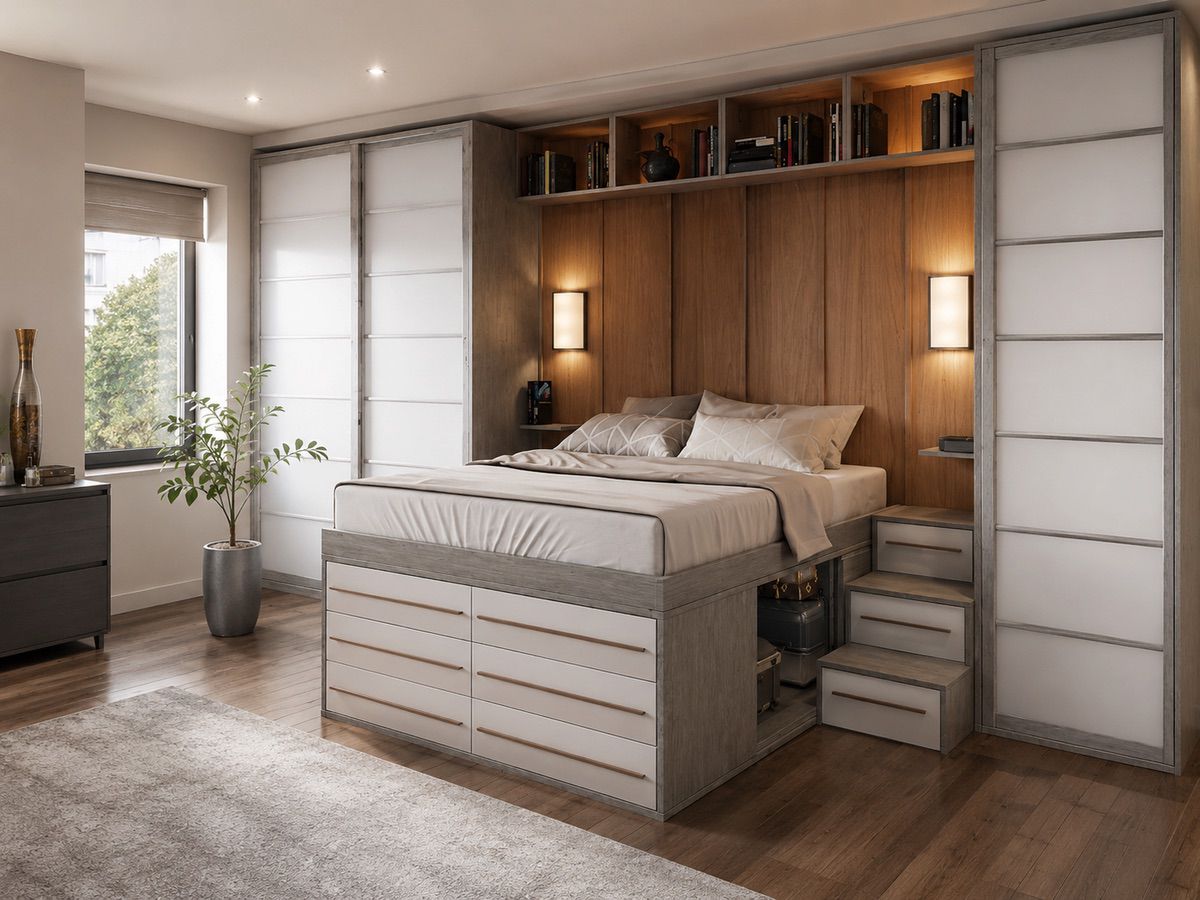
Bedrooms with built-in wardrobes solve this very problem: the bed is raised off the floor, and the space below becomes a closet area. This way, you don’t need to take up an entire wall with a traditional wardrobe, and the room feels more spacious.
Under-bed drawers: when a dresser becomes unnecessary
Another important consideration is whether you really need a separate dresser. In many small bedrooms, a dresser is added because there isn’t enough storage space, but it ends up taking up space that could be used for walking or filling up an already cramped wall.
A neater solution is to make use of the space under the bed. Beds with drawers allow you to incorporate spacious storage without adding a freestanding piece of furniture. This is useful for linens, clothes, seasonal items, or things you don’t want to leave out in the open.
The benefit isn’t just about saving space. Removing a dresser from the room frees up visual space, improves traffic flow, and makes it easier to keep the room tidy.
Pull-out shelves: a more flexible layout
Pull-out carts are a particularly attractive solution when you want accessible storage without taking up space on fixed walls. Unlike a traditional cabinet, the cart is used when needed and then slides back into the unit.
Bedrooms with under-bed storage units allow you to make use of the space under the bed for clothes, linens, or personal items. Of course, you need to allow for the space required to pull them out, but the result can be much neater than a bedroom filled with side tables.
This approach is especially useful when the room doesn’t have any long walls available, when a traditional closet would block the passageway, or when you want to keep the space more open.
Nightstands: Better Small, Wall-Mounted, or Built-In
Nightstands are convenient, but in a small bedroom they can create more problems than you might think. Two traditional 45-50 cm nightstands add nearly a meter to the overall width of the bed. If the room is narrow, this space can make all the difference.
Alternatively, you can use hanging shelves, niches, built-in shelves in the headboard, small side compartments, or built-in elements within the structure. The goal is not to eliminate the function of the nightstand, but to reduce the amount of floor space it takes up.
A well-designed side table should hold only what you really need: a lamp, a book, a phone, glasses, and a charger. Everything else can be stored in drawers, bookshelves, or larger storage containers.
How to Use Bookshelves and Shelving Without Making the Room Feel Cluttered
In a small room, shelves and bookcases can be useful, but they should be used sparingly. Filling all the walls with open shelving can create visual clutter. It’s better to group books and objects in a specific area, keeping the other surfaces uncluttered.
Rooms with built-in bookcases allow this feature to be integrated into the design of the sleeping area. This way, the bookcase isn’t added as a separate piece of furniture, but becomes part of the design.
This is especially helpful when a room needs to hold books, personal items, or documents but doesn’t have space for a freestanding, deep bookshelf.
Long, narrow, or irregular-shaped room: the layout changes
Not all small rooms are the same. In a long, narrow room, it’s best to avoid deep furniture on both sides. It’s better to place the bed and storage units along one main wall, leaving the other wall more open for walking through.
In a nearly square room, on the other hand, it’s easier to work with symmetry, but you still need to check the clearance for doors, windows, closets, and drawers. In an irregularly shaped room, niches and recesses can be useful for custom storage solutions or shallower units.
The best layout isn’t the one that looks the best on paper, but the one that works best in everyday life. A small room should be easy to use, not just photogenic.
In studio apartments, the bed should complement the entire home
In studio apartments, the layout is even more important, because the sleeping area isn’t always separated from the rest of the home. The bed can become the focal point of the entire space, or it can be integrated into a more organized design.
Studio apartments are designed precisely for this purpose: to integrate the bed, storage, and daily living functions into a single system. In this way, the sleeping area is not an isolated, cluttered space, but part of a more comprehensive design.
When there’s only one room, every piece of furniture must have a clear purpose. Fewer separate items mean more order, more flexibility, and a more livable home.
Arranging Furniture in a Small Bedroom: The Secret Is to Consolidate Functions
In conclusion, when arranging furniture in a small bedroom, you should start with the flow of movement, not the furniture itself. First, define the pathways and clear spaces; then choose the bed’s position; and finally, decide where to place the storage units.
In many cases, the best solution is to reduce the number of separate pieces of furniture. A loft bed with built-in storage, drawers, pull-out units, or a matching bookcase can replace several traditional pieces of furniture, freeing up space and making the room look tidier.
The real goal isn’t to fit everything in, but to make the room function well. With a layout designed based on the room’s actual dimensions, even a small bedroom can become comfortable, elegant, and practical for everyday living.