

Furnishing a small bedroom means finding the right balance between comfort, storage, and freedom of movement. In an adult bedroom—especially a master bedroom—the challenge isn’t just fitting the bed in; you also need to include a closet, nightstands, drawers, comfortable walkways, and a tidy space where you can relax.
When square meters are limited, it’s tempting to choose smaller furniture or do without something. In reality, the best solution is often to change your perspective: don’t add separate pieces, but integrate multiple functions into the same space. A bed, for example, can also serve as storage, a closet, a bookshelf, or a space-saving unit.
Before deciding on the furnishings, it’s also helpful to keep the regulatory requirements in mind: for a bedroom intended for two people, the generally recommended minimum floor area is 14 square meters, with a standard ceiling height of 2.70 meters and a window that opens. But simply meeting the minimum requirements isn’t enough: a room can comply with regulations and still be difficult to live in if it’s poorly furnished.
Start with a simple question: What does the room really need to have?
The first step in furnishing a small bedroom is to figure out which functions need to coexist in the same space. Is the bedroom used only for sleeping? Does it need to hold your entire wardrobe? Are there books, suitcases, linens, seasonal clothing, documents, or personal items that need to be stored?
In many small master bedrooms, the problem stems precisely from this: the bed takes up the center of the room, the closet takes up an entire wall, the dresser is squeezed in wherever there’s space, and the nightstands end up narrowing the walkways even further.
To avoid this effect, it’s best to think in terms of priorities. The bed should be comfortable, but storage should also be accessible. A small bedroom can’t afford “excess” furniture: every piece should serve a specific purpose—and, if possible, more than one.
Make use of the vertical space instead of taking up all the floor space
One of the most effective strategies is to make use of vertical space. Shelves, vertical storage units, lightweight bookcases, and elevated storage modules help free up floor space and keep the room tidier. But in very small bedrooms, a loft bed can make all the difference.
A traditional bed takes up a lot of floor space and leaves the area underneath it often unused or difficult to access. A loft bed, on the other hand, transforms that space into a useful area: drawers, rolling carts, a closet, storage units, or custom-built modules can be placed underneath.
SpazioBed double bedrooms are designed with this very principle in mind: using vertical space to make even a compact bedroom more functional, without sacrificing the comfort of a true sleeping area.
Clear the center of the room
A small room immediately feels more livable when the center is kept clear. This doesn’t mean leaving the room empty, but rather preventing the bed, closet, dressers, and chairs from creating constant obstacles.
The space at the foot of the bed, access to the closet, and the ability to make the bed without difficulty are practical considerations that greatly affect the room’s day-to-day usability. A piece of furniture may “fit” within the dimensions, but if it prevents you from moving around or opening a drawer, it isn’t truly functional.
For this reason, in small rooms, it’s helpful to concentrate multiple functions on a single wall or in a built-in unit, leaving the areas for movement unobstructed. The goal is to reduce scattered clutter and create a more open, flowing space.
Choose under-bed storage instead of adding dressers
A separate dresser can be useful, but in a small bedroom it takes up valuable space. If storage can be built in under the bed, the room stays tidier and you avoid cluttering the walls.
Chests of drawers are an effective solution when you need practical storage spaces for linens, clothes, seasonal clothing, or items you don’t want to leave out in the open.
There are two advantages: on the one hand, you gain storage space; on the other, you reduce the need for additional furniture. In a small bedroom, this can make a big difference in how the room feels.
Consider a under-bed storage unit if there isn’t a free wall
One of the most common problems in small master bedrooms is the closet. A traditional closet requires depth, a long wall, and space in front of it to open the doors. When the room is narrow or irregularly shaped, the closet can become the element that disrupts the entire layout.
In these cases, a solution with a storage cabinet under the bed can be much more efficient. Bedrooms with under-bed storage allow you to transform the space beneath the bed into a true closet area, freeing up wall space and walkways.
It’s a particularly good choice when you want to keep the room looking tidier without sacrificing the storage space needed for two adults.
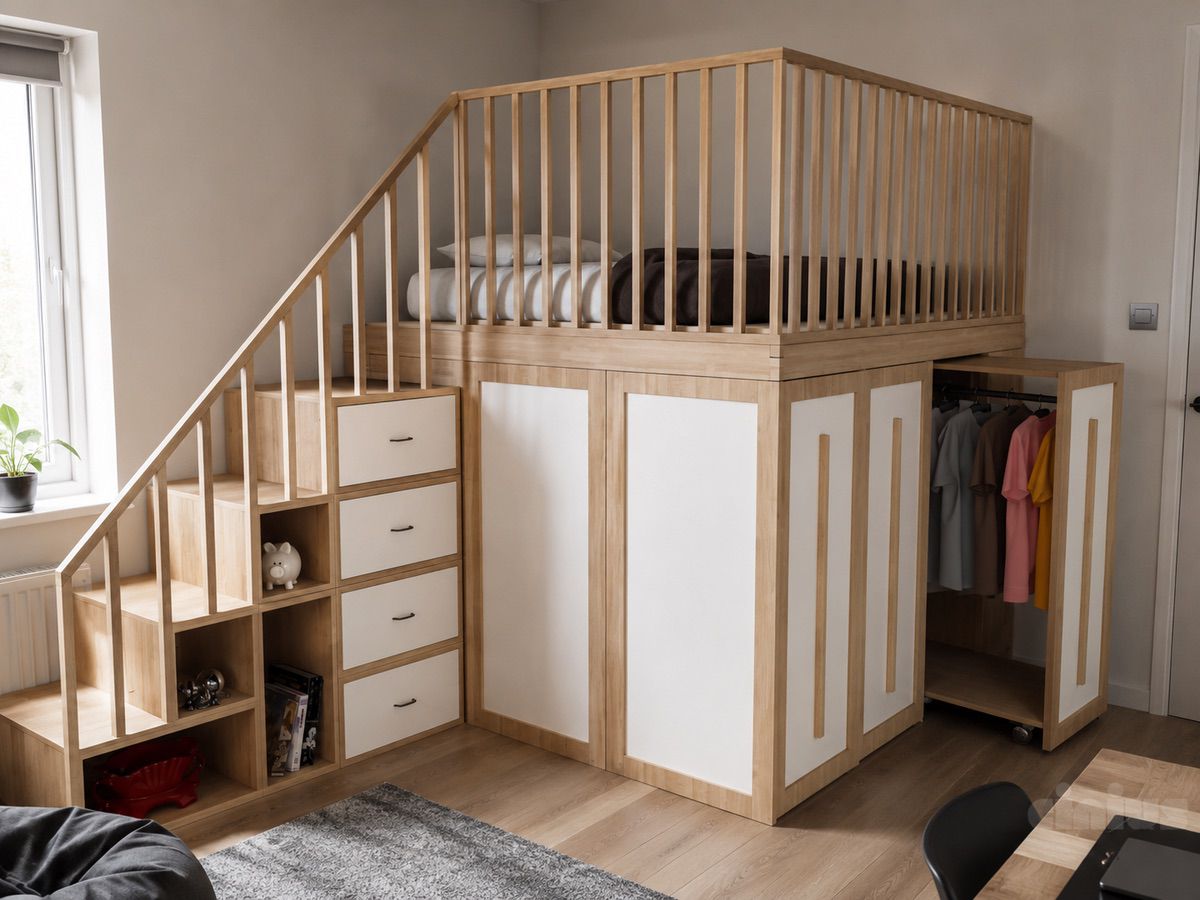
Use carts whenever you need accessible storage
Roll-out drawers are a less common solution than traditional closets, but they’re very useful in small bedrooms. They allow you to make the most of the space under the bed and make clothes, linens, or personal items easily accessible with a simple motion.
Rooms with rolling storage units are designed specifically for those who need everyday storage without taking up an entire wall with a traditional closet.
Of course, pull-out cabinets require space to slide out, so they must be designed based on the room’s actual dimensions. When designed correctly, however, they become a very practical solution: they open, reveal their contents, and close again without creating permanent clutter.
It adds a bookshelf without taking up too much space in the room
Many small bedrooms also need to accommodate books, documents, decorative items, or small personal belongings. However, adding a traditional bookshelf can make the room feel cluttered, especially if it’s deep or placed in a high-traffic area.
Rooms with built-in bookcases allow you to integrate this feature into the room’s overall design, making use of walls, headboards, or vertical spaces that are normally underutilized.
A well-designed bookshelf shouldn’t take up too much space: it can make the room feel cozier, more personal, and tidier, especially if it complements the bed rather than being added as a separate piece of furniture.
Colors, light, and organization: small changes that really make a difference
Not all solutions for furnishing a small room have to be structural. Colors, lighting, and organization also play an important role. Light-colored walls, coordinating textiles, sheer curtains, and uncluttered surfaces help the room appear more spacious.
Natural light should be maximized by avoiding blocking the window with tall furniture or curtains that are too heavy. Artificial lighting, on the other hand, should be well distributed: general lighting, reading lights near the bed, and, if necessary, lights built into the structure.
Mirrors can help make a space feel larger, but they should be used sparingly. In a small room, the goal isn’t to fill it with visual tricks, but to create a simple, cohesive space that’s easy to keep tidy.
Small bedroom or studio apartment: when the bed sets the tone for the whole home
In studio apartments, the problem becomes even more apparent. The bed doesn’t just take up one room; it affects the entire living space. If it’s always in the center of the room, it can make the home less flexible and harder to organize.
Studio suites help transform the sleeping area into a more comprehensive system, with built-in storage and integrated features. This way, the bed is no longer just a piece of furniture taking up space, but becomes part of a smarter living design.
This approach is also useful in traditional small rooms: when space is limited, every element should help enhance the room, not just fill it up.
Why Choose a Custom-Designed Solution
A small bedroom furnished with standard furniture can work, but it often leaves unused space or forces you to make inconvenient compromises. A closet that’s too deep, a poorly placed dresser, or a traditional bed without storage can make the room less livable.
A custom-designed solution, on the other hand, is based on actual measurements: width, length, height, the location of doors and windows, storage needs, and daily routines. This is where experience makes all the difference.
SpazioBed brings over 30 years of experience in designing space-saving solutions to this field. The difference isn’t just aesthetic: loft beds, under-bed storage, drawers, rolling units, and bookshelves are conceived as parts of a single system, designed to last and to adapt to the actual room.
Furnishing a Small Bedroom: The Best Solution Is One That Frees Up Space
In conclusion, furnishing a small bedroom doesn’t mean sacrificing comfort. It means carefully choosing where to place the bed, how to organize storage, and which functions to incorporate into the bed frame itself.
Shelves, light colors, natural light, and organization go a long way. But when space is really limited, the most effective solution is often to rethink the bed as a space-saving element: tall, with storage, and integrated with a closet, drawers, rolling cabinets, or a bookshelf.
The bedroom should remain a place of rest, not a storage room filled with furniture. With the right design, even a small room can become elegant, functional, and cozy—capable of holding everything you need without sacrificing the quality of your daily life.