
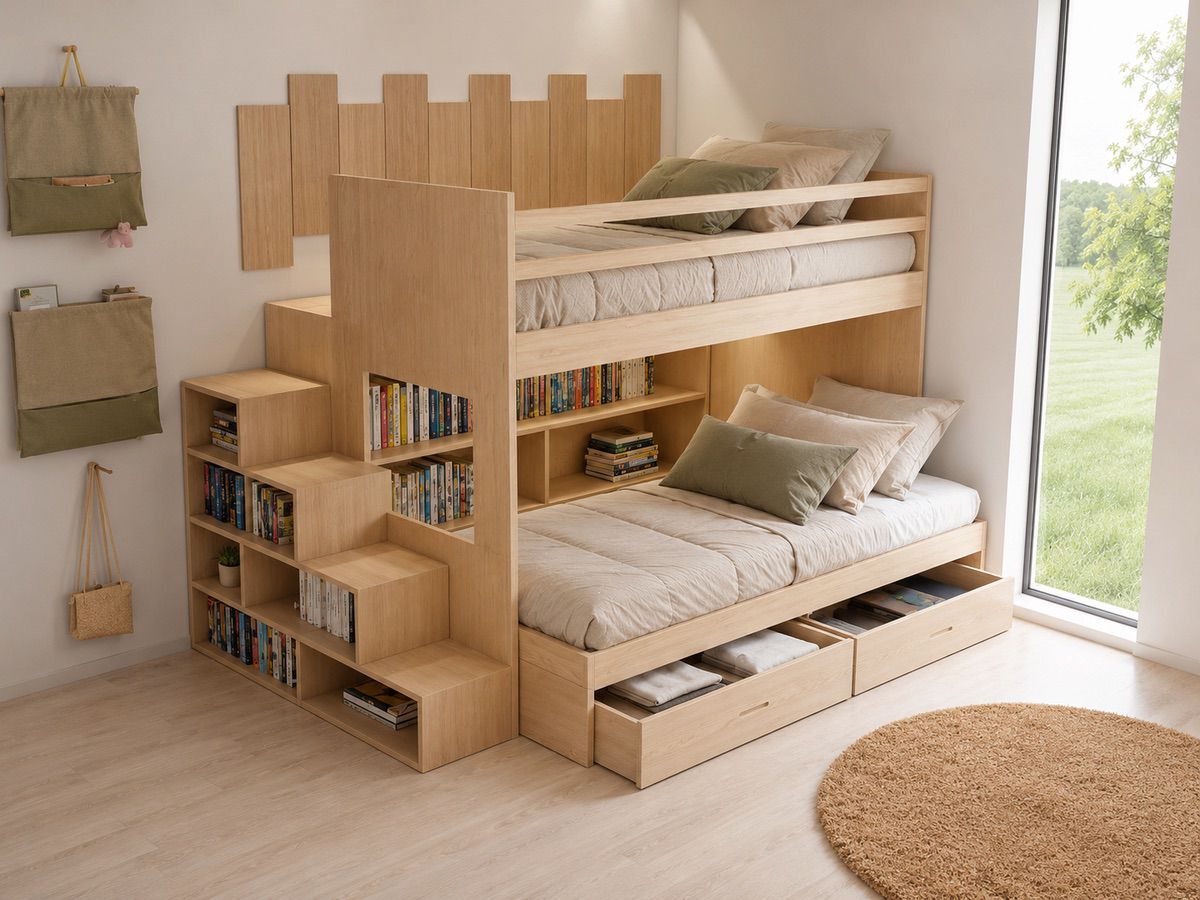
Creating a space-saving bedroom isn’t just about buying smaller furniture. It means designing a room that can accommodate multiple functions within the same space: sleeping, studying, getting dressed, playing, storing items, and moving around freely. When space is limited, the most common mistake is to start with individual pieces of furniture: first the bed, then the closet, then the desk, then a few shelves wherever there’s room left. In reality, a small bedroom works best when it’s conceived as a single, cohesive design, where every element has a specific role and where the room’s volume is utilized in height, depth, and width.
That’s why small, space-saving bedrooms shouldn’t be seen as a stopgap solution, but rather as a smarter way to organize compact spaces—especially when the room needs to grow along with the child or teenager.
Before choosing furniture, determine the room’s purpose
The first step in creating a space-saving children’s room is to figure out what it really needs to hold. A room for a young child will have different needs than one for a teenager; a room for an only child will be different from a room shared by two siblings; a room used only for sleeping won’t require the same organization as a room with a daily study area. So, before even thinking about a bed or closet, it’s best to answer a few practical questions: Do you need a built-in desk, or can it be a pull-out desk? How many clothes need to be stored in the room? Will a second bed be needed? Will the room also need to accommodate toys, books, sports equipment, or suitcases?
This step is important because it helps you avoid unnecessary furniture. In a small space, every item you add must serve a real purpose. A well-designed children’s bedroom isn’t one with as much storage as possible, but one where every piece of storage is in the right place.
Check the minimum requirements, but design with livability in mind
From a regulatory standpoint, in Italy, a single bedroom must generally be at least 9 square meters, while a bedroom intended for two people must be at least 14 square meters. These are important guidelines, but they aren’t enough to determine whether a bedroom will be comfortable for everyday life. A room may meet the minimum size requirements but still be difficult to furnish if it is very narrow, if the door is in an inconvenient location, if the window limits the use of one wall, or if the radiator is right where you’d like to put the closet.
To create a space-saving children’s room, you need to shift your focus from square meters to actual usage: How much free space is left to move around? How easy is it to open drawers, cabinet doors, and rolling cabinets? Does the bed block the way? Does the desk get natural light? Are the storage units accessible even to a child?
Choose the bed as the focal point of the design
In a small bedroom, the bed is almost always the first thing to rethink. A traditional bed takes up a lot of floor space and leaves little room for other furniture. For this reason, when you want to create a space-saving bedroom, it’s helpful to ask yourself whether the bed can also serve as storage, a structural element, a closet, a bookshelf, or the starting point for a more complete layout. Space-saving one-bed children’s rooms are ideal when the room is intended for a single child or teenager but still needs to accommodate a closet, a study area, and open space. In these cases, a loft bed allows you to use the space underneath for dressers, rolling carts, closet compartments, or storage units.
If, on the other hand, the room is shared, the design changes: it’s not just a matter of adding two beds, but of finding a way to accommodate two sleeping areas without completely sacrificing the rest of the room.
When you need two beds, think vertically or use a nesting design
In a small bedroom for two children, traditional side-by-side beds only work if the room is wide enough. When space is limited, it’s best to consider more compact solutions: bunk beds, staggered beds, corner beds, a pull-out bed, or configurations with one high bed and one low bed.
Space-saving children’s bedrooms with 2 or 3 beds address this very issue: increasing the number of sleeping spots without turning the entire room into a dormitory. When ceiling height allows, children’s bedrooms with bunk beds can also be an effective choice, especially when combined with storage ladders, safety rails, bookshelves, and custom-made units. For more flexible needs, however, children’s bedrooms with pull-out beds provide a second sleeping spot only when needed, leaving more free space during the day.
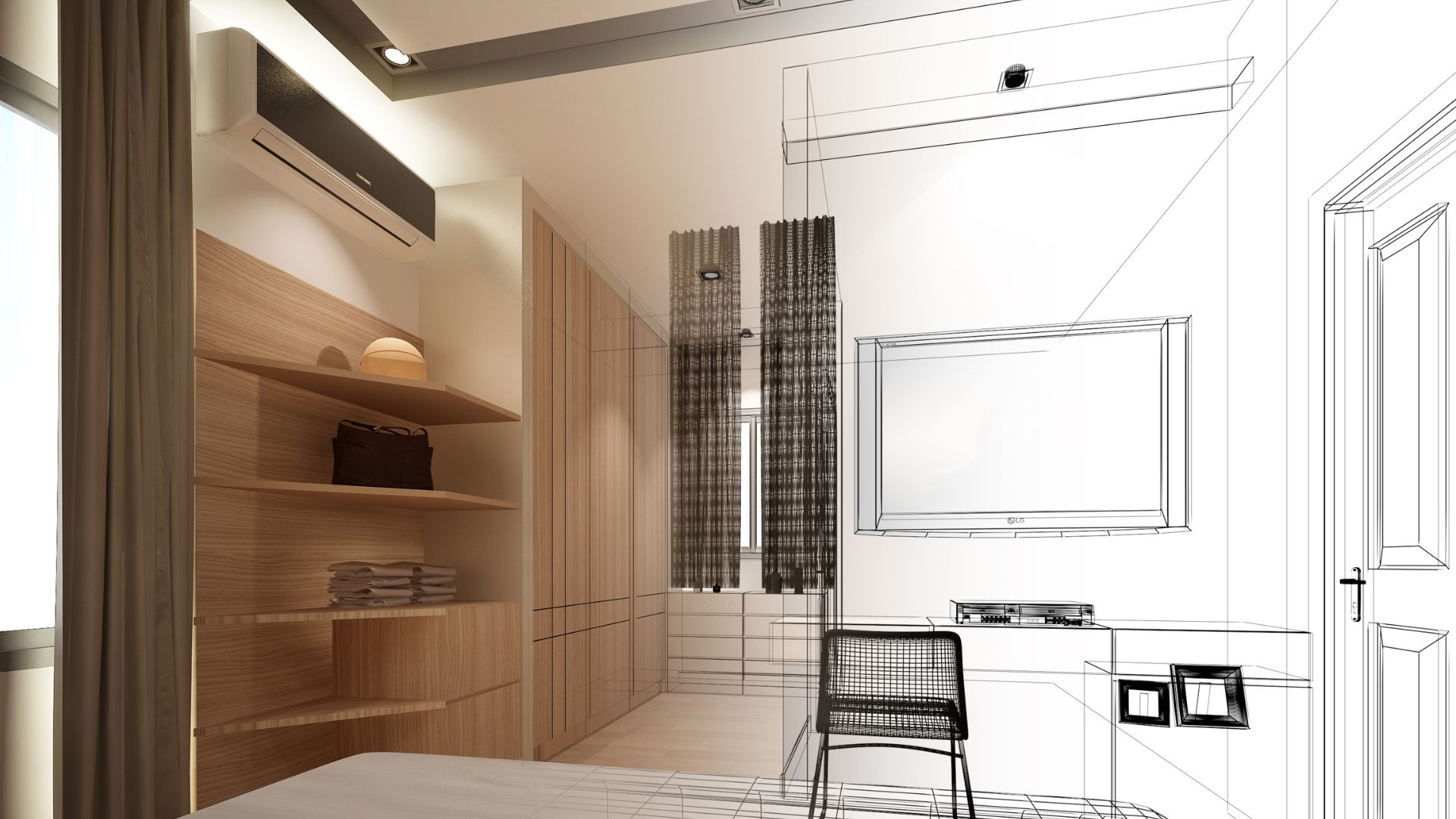
It combines a wardrobe, storage units, and a desk into a single unit
A truly space-saving bedroom doesn’t strictly separate each function. If the bed is on one side, the closet on the other, the desk against a third wall, and the bookshelf wherever it happens to fit, the room risks becoming fragmented and cluttered. Instead, it’s better to consolidate multiple functions into a cohesive layout. A ladder can have drawers. The space under the bed can become a closet. A headboard can accommodate shelves or lights. A side panel can be turned into a bookshelf. A desk can be suspended, pull-out, or built into the unit.
This approach is particularly useful in children’ s bedrooms with walk-in closets, where the space under the bed is used to create a more organized and less intrusive storage area than a traditional closet.
Don’t forget about light, colors, and the perception of space
Creating a space-saving children’s bedroom isn’t just about the dimensions. Perception matters, too. Light colors, bright materials, uncluttered surfaces, and walls that aren’t too busy help the room feel more spacious. Mirrors can be useful, but they should be used in moderation, especially in a children’s bedroom. Natural light should be maximized by keeping the window area unobstructed and, whenever possible, placing the desk in a well-lit spot. Artificial lighting should also be planned by zone: general lighting, a study light, a bedside light, and, if necessary, lights built into the furniture.
The real goal is to reduce visual clutter. The fewer scattered items there are, the more spacious and livable the bedroom appears.
Design a child’s bedroom that can evolve over time
A child’s bedroom doesn’t stay the same forever. Clothes, books, toys, school, habits, and the need for independence all change. That’s why, when space is limited, it’s even more important to choose a solution that isn’t designed just for the present.
SpazioBed children’s bedroom sets are designed as modular and customizable systems: they’re not just pieces of furniture to be placed in a room, but layouts designed to organize different functions within a single design. This allows you to start with the actual dimensions of the room and create a solution tailored to the number of beds, storage needs, and the family’s lifestyle. If you’d like to explore this topic from a practical perspective, you can also read the article on how to reclaim space in a child’s bedroom—a useful guide when the room is already furnished but no longer works well.
Can a small bedroom be fully furnished?
Yes, but only if it’s designed thoughtfully. Creating a space-saving bedroom means setting priorities, making the most of the ceiling height, minimizing floor space, and integrating multiple functions into just a few elements. There’s no need to fill every wall—you need to figure out where to place the bed, storage, and study area to leave enough open space to make the room truly livable.
In some cases, a solution with a loft bed and storage will suffice. In others, you’ll need a second pull-out bed, a bunk bed, a walk-in closet under the bed, or a bedroom set for three children. When the room has a unique shape—for example, narrow, long, or irregular—it can be helpful to consider design approaches similar to those used for a long, narrow bedroom, where the layout becomes just as crucial as the furniture chosen. The design ultimately makes all the difference: a small bedroom furnished with standard pieces may always feel cramped; a custom-designed, space-saving bedroom, on the other hand, can feel organized, complete, and surprisingly comfortable.