
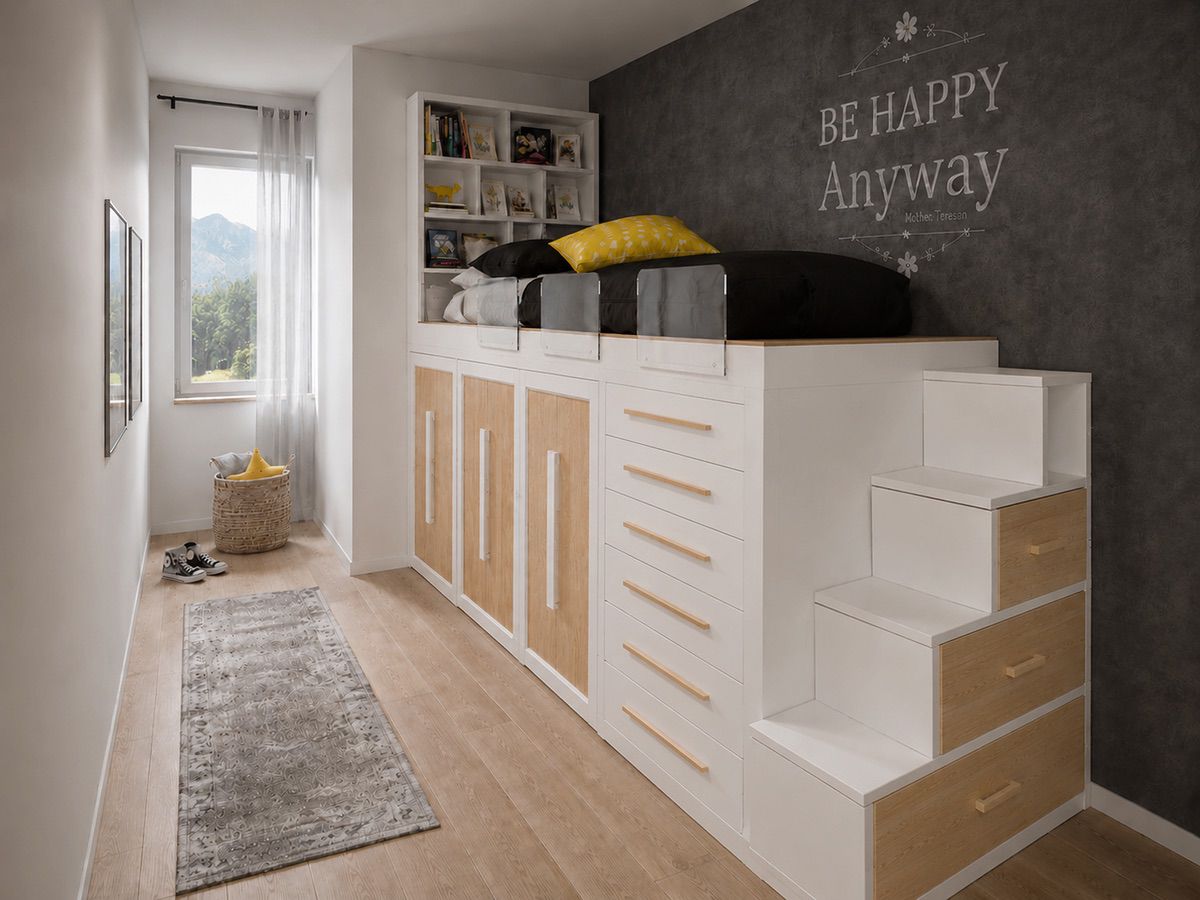
When it comes to the minimum width of a child’s bedroom, the answer is never just a number. Italian regulations primarily establish minimum floor areas, heights, and health and safety requirements, while the actual width of the room depends on its shape, the location of the door and window, and the type of furniture you plan to place inside. In other words, a child’s bedroom may be “up to code” in terms of square meters, but it can still be difficult to use if it’s too narrow, too long, or furnished with standard pieces that aren’t well-suited to the space. That’s why it’s helpful to distinguish between the legal minimum size and the size that’s truly comfortable for living in the room. Small bedrooms require precisely this kind of thinking: it’s not enough to simply ask how many square meters the room has; you need to figure out how to transform those square meters into usable space for sleeping, studying, getting dressed, and moving around.
What do the regulations say about minimum dimensions?
The most frequently cited reference for residential buildings is the Ministerial Decree of July 5, 1975, which specifies the minimum floor areas for bedrooms: 9 square meters for a bedroom intended for one person and 14 square meters for a bedroom intended for two people. The same regulation also sets requirements for interior ceiling height—typically 2.70 m—and mandates that bedrooms, living rooms, and kitchens have a window that opens. These values are fundamental because they define a minimum standard for habitability. However, they do not directly specify a fixed minimum width for a bedroom. A 9-square-meter room could, for example, be approximately 2.50 m wide and 3.60 m long, or have different proportions. From a practical standpoint, however, these proportions significantly affect how the room can be furnished.
It is always important to check your municipality’s building code as well and, in the case of renovations or interior modifications, to consult with a professional. National regulations provide a general framework, but certain specific cases may require further review.
So what is a truly practical minimum width?
For a single bedroom, a width of around 2.50 meters can already be manageable, especially if the room has good depth and the furniture is chosen wisely. Between 2.50 and 2.80 meters, you enter a range that’s often more convenient, because it becomes easier to fit a bed, maintain a clear path, and organize at least one wall of storage. The problem arises when you try to furnish a narrow room with traditional furniture: a floor-standing bed, a deep wardrobe, a nightstand, a separate desk, and a freestanding dresser. In these cases, even a bedroom with sufficient floor space can become uncomfortable because the furniture takes up all the space along the sides.
For this reason, when space is limited, it’s best to design the bedroom vertically. A loft bed or a space-saving structure allows you to use the same floor space for multiple functions: a bed on top, a closet below, drawers, storage carts, a bookshelf, or a built-in desk.
Can a narrow bedroom accommodate a SpazioBed?
Yes, in many cases a narrow bedroom can accommodate a SpazioBed solution, but you need to carefully consider the width, length, and overall dimensions. The SpazioBed catalog features modular systems with a wide range of bed widths, from more compact options at 86/96 cm up to wider configurations at 126, 146, 166 cm, and beyond, with most configurations having a length of around 206 cm. This is an important point: in a small bedroom, it’s not always necessary to make the room larger—which is obviously impossible—but rather to reduce the number of separate pieces of furniture. If the bed incorporates storage, a closet, or a bookshelf, the opposite wall can remain more open, and the space feels more organized.
For a room intended for a single child or teenager, single-bed bedroom sets are often the most straightforward solution: they allow you to design compact layouts, with a loft bed and usable storage space underneath.
How much space is needed in front of the bed and other furniture?
The minimum width of a small bedroom isn’t determined just by looking at the bed. You also need to consider walkways, opening drawers, using the ladder, accessing the closet, and the space needed to sit at a desk. A traditional single bed may seem compact, but if it’s positioned poorly, it can block the center of the room. A closet with hinged doors can be difficult to use in a narrow bedroom. A desk that’s too deep can block the walkway. For this reason, sliding, pull-out, or built-in storage solutions work best in small bedrooms.
SpazioBed solutions often incorporate rolling units, sliding doors, built-in drawer units, cube-style ladders, and under-bed modules. This allows you to make the most of the available width in a more efficient design, avoiding the need to fill the room with freestanding furniture.

When space is limited, is a low bed or a high bed better?
It depends on the child’s age, the height of the room, and the family’s habits. However, when space is truly limited, a loft bed can be one of the most effective solutions because it frees up space beneath the sleeping area. A traditional low bed takes up floor space and leaves little room for other furniture. A loft bed, on the other hand, can accommodate a closet, hanging rods, drawers, or a small walk-in closet underneath. This way, the bedroom remains more compact, and storage is concentrated where normally there would only be the space taken up by the bed.
Children’s bedrooms with walk-in closets are a clear example of this approach: the bed is not just a place to sleep, but becomes part of a design that also solves the problem of storage.
What if the bedroom is long and narrow?
A long, narrow bedroom requires a different approach than a nearly square room. In this case, the limited width can create a corridor-like effect and make it difficult to arrange furniture along both walls. The best solution is often to concentrate the main pieces of furniture along one wall, leaving the other wall more open for passage. You can place a tall bed along the main wall, with storage underneath, shallow bookshelves, or a wall-mounted desk. The goal is to prevent your daily path from being obstructed by furniture that’s too deep.
To gain a deeper understanding of the design principles behind narrow rooms, it may also be helpful to read the article on long, narrow bedrooms, since many of the same layout principles apply to children’s bedrooms as well.
How can you tell if the bedroom is too small?
A child’s bedroom is too cramped not only when it doesn’t meet the minimum space requirements, but also when it doesn’t allow for the comfortable use of essential furniture. Some signs are obvious: the bed blocks the closet door, the desk chair blocks the passageway, the drawers don’t open all the way, the ladder to the loft bed takes up all the available space, or there isn’t enough room to move around naturally. In these cases, before giving up on the room or assuming it’s impossible to furnish it, it’s worth considering a space-saving design. Sometimes just a few changes are enough: raising the bed, using sliding doors, integrating the desk, replacing a traditional closet with under-bed storage units, or choosing drawers and pull-out carts.
If you’re starting with a bedroom that’s already furnished, you might also find the guide on how to maximize bedroom space useful, while those who need to design everything from scratch can learn more about how to create a space-saving bedroom.
Minimum bedroom width: size matters, but the design matters more
In short, there is no single minimum width that applies to all children’s bedrooms. Building codes focus primarily on floor area, ceiling height, windows, and health and safety requirements. From a furnishing perspective, however, a width of around 2.50 meters can be a good starting point, provided the design is carefully planned. A narrow room furnished with standard pieces of furniture can quickly become uncomfortable. The same room, however, when designed with a custom solution, can accommodate a bed, closet, desk, and storage units in a much more organized way.
SpazioBed children’s bedrooms were created precisely for this reason: to adapt the room’s functions to the available space, without simply placing pieces of furniture side by side. When space is limited, it’s not just that extra centimeter that makes the difference, but the way each centimeter is used.