
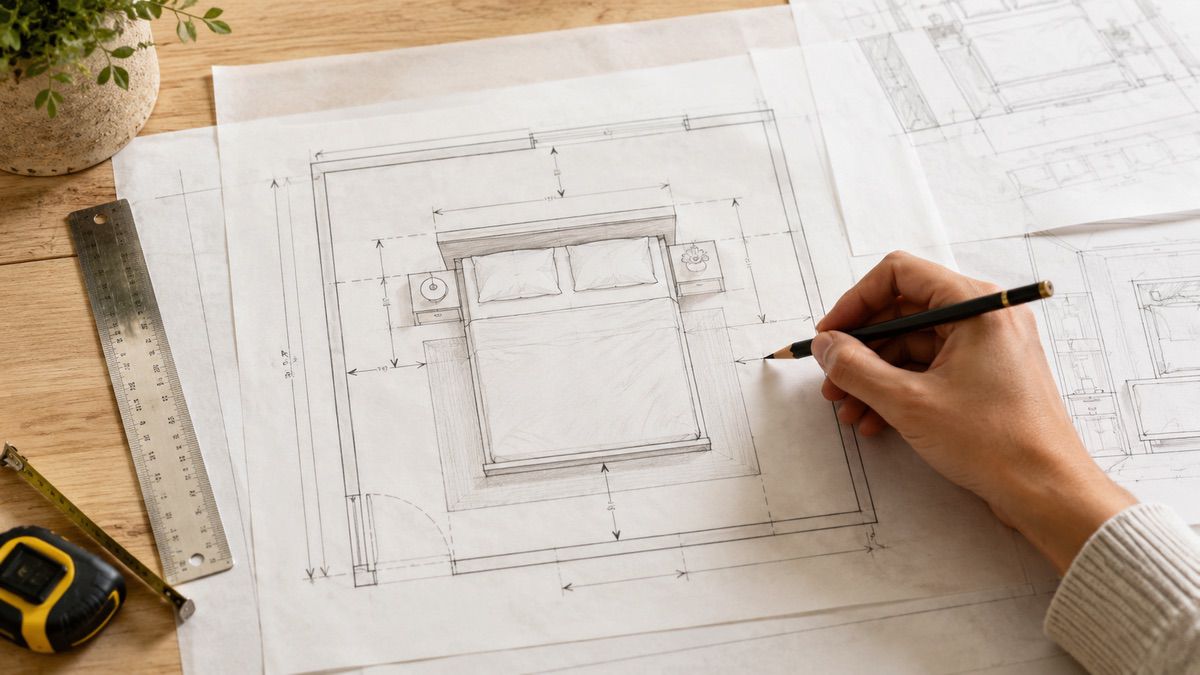
It’s essential to figure out how much space you’ll need for a bed and nightstands in a bedroom before choosing the furniture. The bed is the central element of the room, but it never stands alone: on either side, you need surfaces to rest things on, space to walk by, lighting, electrical outlets, and enough room to move around without making the bedroom feel cramped.
In a traditional bedroom, a standard 160-cm double bed with two 45-50-cm nightstands requires a total width of approximately 250-270 cm, considering only the bed and nightstands. If you also want more comfortable space to walk around the sides, the usable width of the room should increase to 280–300 cm.
These measures, however, are just a starting point. In small bedrooms, studio apartments, or irregularly shaped rooms, the most useful question isn’t just “Will a bed and nightstands fit?”, but: Will the room still feel comfortable once they’re in place?
How big is a bedroom set with nightstands, really?
To calculate the space needed, you must add up three elements: the width of the bed, the width of the nightstands, and small side margins. A single bed can be as narrow as about 80–90 cm, while a traditional double bed is often around 160 cm wide. Nightstands, on the other hand, are typically between 40 and 50 cm wide.
In the case of a 160-cm double bed with two 45-cm nightstands, the total width is already 250 cm. If the nightstands are 50 cm wide, the total width is 260 cm. To this measurement, you must then add any edges of the frame, the headboard, the minimum clearance required to open drawers, and space for passing by on the side.
That’s why a bedroom that’s 260 cm wide may seem sufficient on paper, but can feel cramped in everyday life. If the bed takes up almost the entire wall, there’s little room to walk past it, and the nightstands risk being more decorative than truly functional.
SpazioBed bed sizes: from 86 to 186 cm
One of the features that sets SpazioBed solutions apart is the ability to configure the bed frame in different widths. Recommended widths start at 86 cm and can go up to 186 cm, with a standard length of approximately 206 cm.
This allows for the design of both single or compact beds and larger solutions for adults. The dimensions are determined during the design phase based on the available space, the chosen layout, and the intended use: a single bedroom, a compact double bedroom, a guest room, a studio apartment, or a multifunctional space.
The advantage isn’t just having as many size options as possible, but being able to adapt the bed to the actual room. In a small bedroom, switching from a bed that’s too large to one that’s a better fit can free up precious centimeters for walkways, nightstands, drawers, or rolling carts.
How much space is needed on either side of the bed?
In a comfortable bedroom, there should be enough space on either side of the bed to walk through. It’s not always possible to have a lot of space, especially in small rooms, but it’s important to avoid having the bed squeezed in a way that makes it difficult to get in and out of bed or make the bed.
As a general rule, 50–60 cm of space on either side is sufficient for moving around. If the room allows it, 70 cm or more makes daily use more comfortable. In a small room, however, it may be necessary to choose one side that’s more spacious and one that’s more compact, or to forgo the traditional nightstand on both sides.
The key is to assess the space not only when you’re standing still, but also when you’re moving around. You need to be able to open drawers, reach the outlet, put down a book, turn on the light, and make the bed without having to constantly move things out of the way.
Traditional nightstands or built-in shelves?
Classic nightstands are practical, but in a small bedroom, they can take up more space than you might think. Two 50-cm nightstands add one meter to the overall width of the arrangement. If the room is narrow, this can make the difference between a comfortable bedroom and a cramped one.
For this reason, in some cases, it’s worth considering alternative storage solutions: side shelves, built-in niches, storage-equipped headboards, small open compartments, or storage spaces built into the bed frame. The key is to maintain the bedside table’s function without necessarily taking up the same floor space.
The SpazioBed Double Rooms allow you to think exactly this way: the bed is not a standalone piece, but part of a design that can incorporate storage, side tables, stairs, lighting, rolling carts, or bookshelves.
Bed and nightstands in a small master bedroom
In a small master bedroom, the bed takes up most of the available space. If you add two traditional nightstands, a closet, a dresser, and perhaps a bookshelf, the room can quickly become crowded.
In these cases, the solution isn’t always to minimize everything, but to choose smarter pieces. For example, beds with built-in drawers allow you to make use of the space under the bed, reducing the need for a separate dresser.
This frees up wall space and walkways. The nightstand can stay, but the room isn’t cluttered with too many freestanding pieces of furniture. In a small bedroom, removing a freestanding piece of furniture is often more worthwhile than gaining a few centimeters in width on the nightstand.
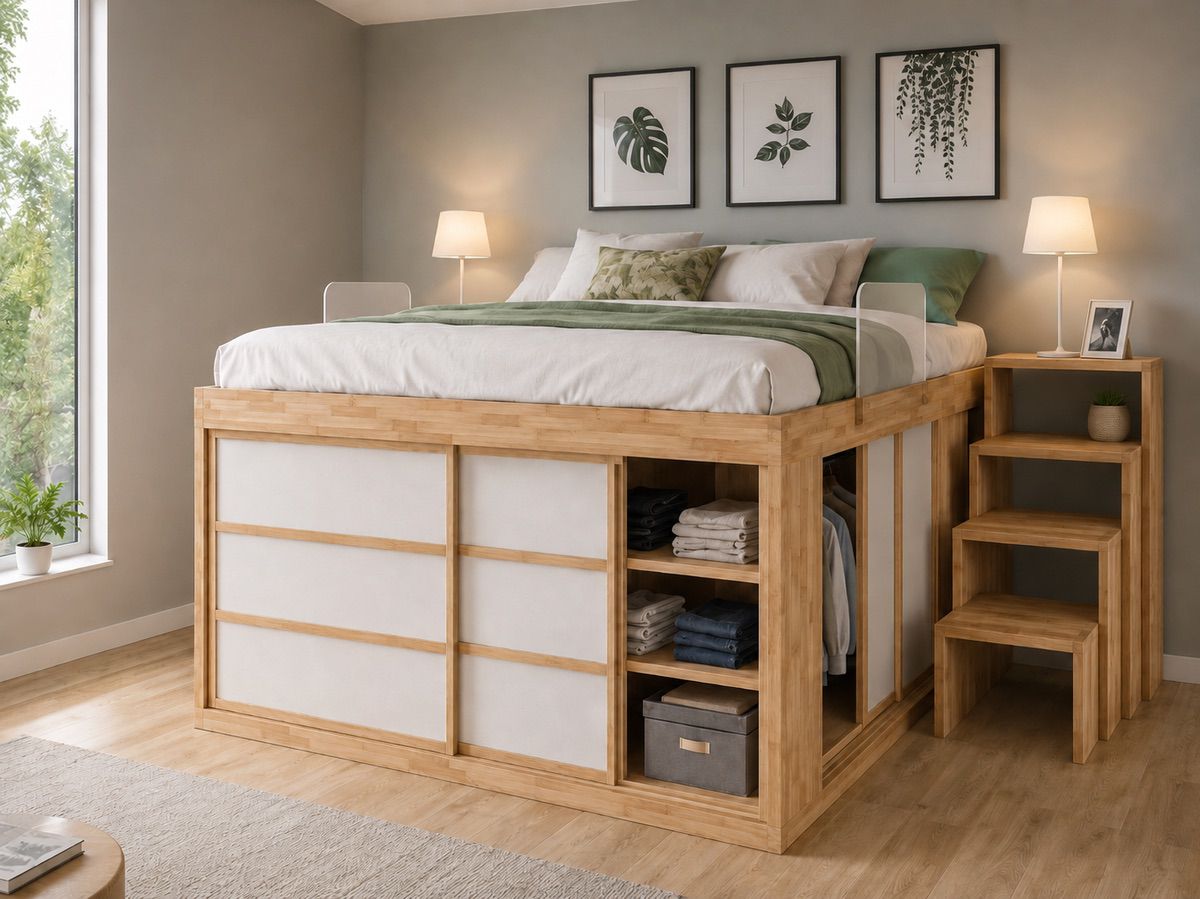
When a nightstand can double as a bookshelf or storage unit
A nightstand isn’t just for holding a lamp. It often holds books, glasses, chargers, medications, small personal items, and everyday accessories. If space is limited, these items can be organized differently.
A built-in headboard, an integrated bookshelf, or an open-shelf unit can replace or complement a traditional nightstand. Bedrooms with built-in bookshelves are especially useful when you want space for books and other items without adding deep floor-standing furniture.
This way, the bed remains comfortable, but the surrounding area isn’t cluttered. The daily storage solution can be placed on the side, above the headboard, built into the staircase, or incorporated into a larger structure.
Loft bed: more space underneath, less furniture around it
A loft bed completely changes the way you plan the sleeping area and nightstands. The width of the bed remains important, but the space underneath the frame can be used for storage. This helps keep the rest of the bedroom uncluttered.
Bedrooms with built-in cabinets are an interesting solution when there isn’t a free wall for a traditional closet. The bed is raised, and the lower section becomes a closet or storage area.
In these cases, the nightstand can be designed differently: not necessarily as a 50-cm-wide side table, but as a surface integrated into the headboard, the staircase, or a nearby structure. The result is a more compact—yet more functional—bedroom.
Pull-out shelves: storage without taking up wall space
Another way to reduce clutter around the bed is to use pull-out carts. Instead of adding side tables or deep cabinets, storage is placed under the bed frame and made accessible when needed.
Bedrooms with under-bed storage carts allow you to organize clothes, linens, and personal items by making use of the space under the bed. Of course, you need to allow for the space required to pull them out, but the advantage is that you can avoid having fixed furniture against every wall.
This approach is especially useful in narrow rooms or studio apartments, where every free wall can be used for moving around, working, creating a living area, or simply maintaining visual order.
How much space is needed in terms of length?
In addition to width, length must also be taken into account. A traditional bed with a 190- or 200-cm mattress can measure approximately 200–210 cm when including the frame and headboard. SpazioBed models have a standard length of approximately 206 cm, which should be verified based on the selected configuration.
There should be enough space at the foot of the bed to walk through. If the room is very narrow, be mindful of drawers, benches, storage units, or furniture placed against the wall. Even a low piece of furniture at the foot of the bed can be inconvenient if it blocks the passageway or prevents other pieces of furniture from opening.
That is why the design must always take the entire room into account: the bed, nightstands, closet, door, window, radiator, outlets, and clearance spaces. The bed’s dimensions alone are not enough.
Sleeping Area and Nightstands in Studio Apartments
In studio apartments, this issue becomes even more important. The bed isn’t just part of the sleeping area—it sets the tone for the entire space. If it takes up too much space and requires two traditional nightstands, it can limit the flexibility of the entire home.
Studio apartments help integrate a bed, storage, and surfaces into a more compact system. This way, the sleeping area doesn’t feel like a cluttered space, but rather as part of a more organized living solution.
In a studio apartment, it’s often better to forgo the traditional nightstand and opt for built-in storage, shelves, multifunctional headboards, or narrower side units. The functionality remains the same, but the space is used more efficiently.
Bedroom nightstands: The right size depends on the design
In summary, for a standard double bed with two nightstands, you’ll need approximately 250–270 cm in width just for the bed itself, while a more spacious room should be around 280–300 cm, taking walkways into account. In terms of length, it’s best to allow for at least 206–220 cm, depending on the bed frame, headboard, and space at the foot of the bed.
For single beds or more compact models, the space required can be much smaller. SpazioBed frames range in width from 86 cm to 186 cm, with nightstands or side tables that can be traditional, built-in, or replaced by storage solutions.
The correct answer, therefore, is not a one-size-fits-all solution. The bedside area should be designed based on the room, your habits, and the amount of storage needed. When space is limited, the best solution is to turn the bed into a complete system: not just for sleeping, but also for storage, a closet, drawers, a bookshelf, and daily organization.