
Buying furniture online offers obvious advantages: wide selection, competitive prices and the convenience of receiving everything at home. The main doubt, however, is always the same: “What if it doesn’t fit?”
Getting the measurements wrong means not only risking that a piece of furniture will not fit in the house, but also compromising the livability of the room, making it cramped and nonfunctional. This is especially true for compact rooms such as double rooms, small bedrooms or study areas carved out of a few square meters.
Not just width: pay attention to technical encumbrances
When you read the dimensions of a piece of furniture on an e-commerce website, you usually find width, depth, and height. These, however, are often “nominal” measurements. Before buying, always consider the actual maximum footprint, including frames, protruding handles, feet or side elements.
- Measure the wall in several places: base, center and height. Walls are not always perfectly straight.
- Leave 1-2 cm tolerance: these are needed to compensate for baseboards, uneven walls or small out-of-square.
- Check outlets and thermostats: the cabinet should not cover electrical outlets, switches or important technical elements.
This control is even more important when choosing space-saving furniture for boys’ bedrooms, where every inch must remain truly usable.
The most common mistake: forgetting the opening radius
One of the most common mistakes is measuring furniture space only when closed, without considering how it will be used every day. Doors, drawers, chairs and windows need space to open and move properly.
- Closet doors: a standard door can measure about 45-60 cm. Check that, once open, there is room left to move around in front.
- Drawers: they can protrude from 30 to 50 cm. In a small room, this detail completely changes the perception of space.
- Windows and doors: a piece of furniture that is too tall or deep can prevent a window from opening fully or bump into the door of the room.
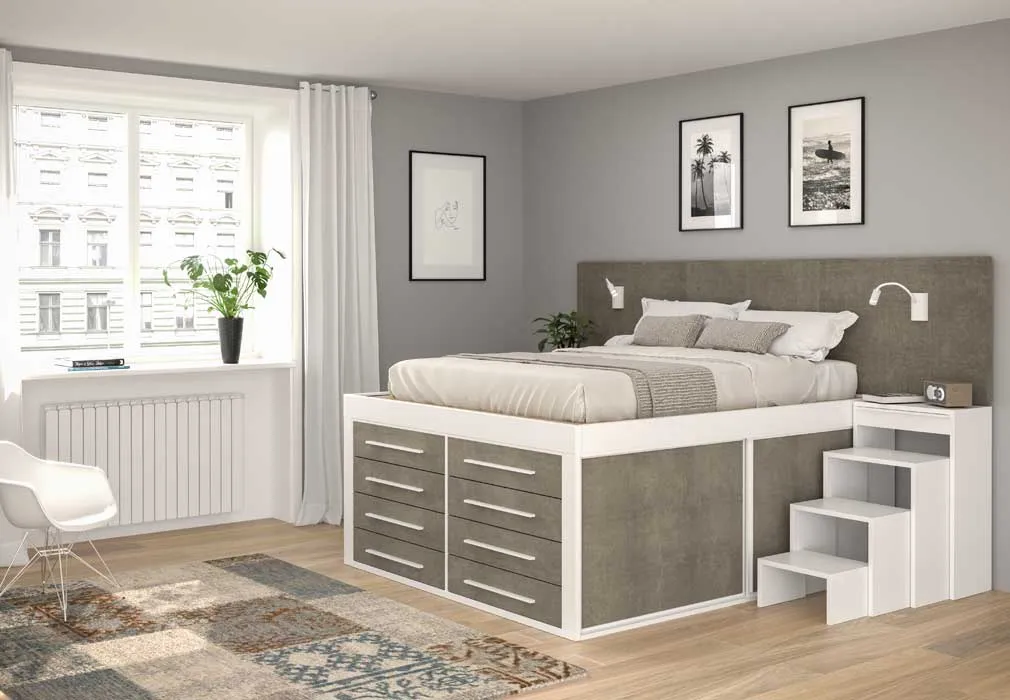
Therefore, in compact rooms it pays to consider smart solutions, such as high beds, built-in drawers or structures designed to take advantage of volume without blocking passageways.
The minimum passage space for not feeling stuck
Ergonomics is fundamental to living comfort. A room that is too full generates visual stress and makes even everyday gestures more uncomfortable.
- Between bed and closet: keep at least 60-70 cm for easy walking.
- Around the bed: the ideal space to redo sheets and move around without bumping into edges is at least 50 cm per side.
- Behind a desk: calculate at least 80 cm between the edge of the table and the wall, so the chair can retract comfortably.
If you need to design a room that combines work, relaxation and storage, you can lean toward studio and living room solutions, where space management is a central part of the design.
Practical tricks before purchase
If you have doubts about the aesthetic and spatial performance of a piece of furniture seen online, you can do two simple tests before ordering.
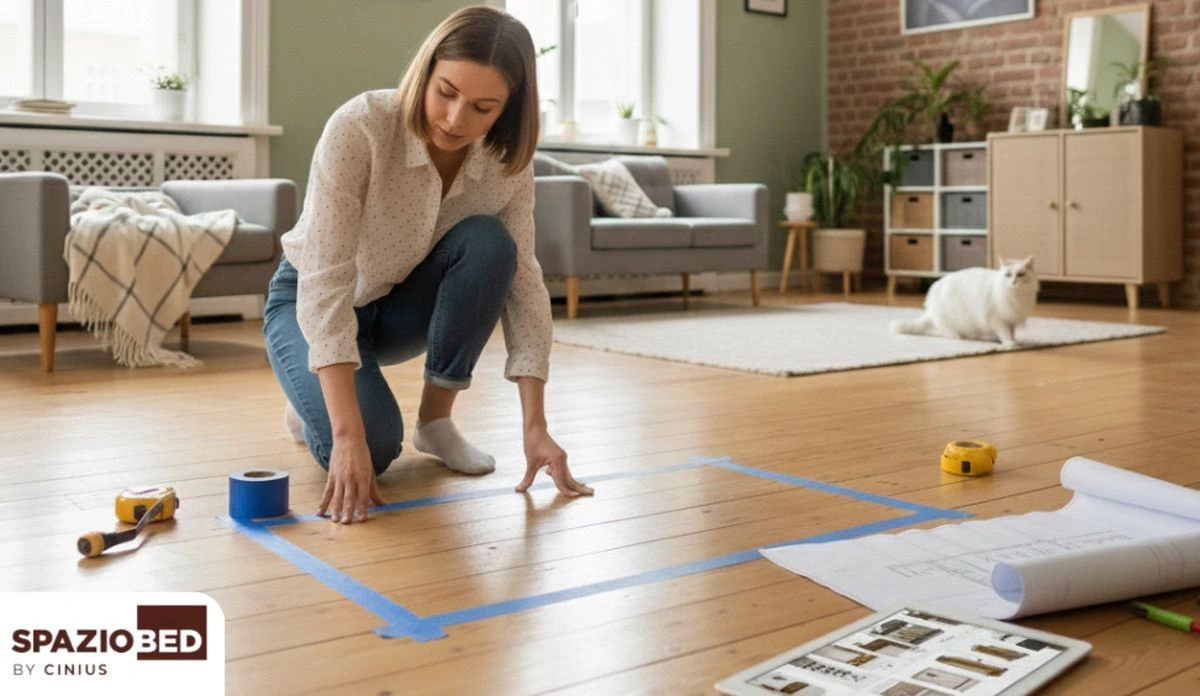
- Paper tape method: draw the actual footprint of the cabinet on the floor, including door and drawer openings. Walk around it for a day: you’ll know right away if the space is sufficient.
- Cardboard templates: if the furniture is tall, such as a closet or bookcase, use cardboard boxes to simulate volume. It will help you figure out if the room will feel too closed or stuffy.
Why choose tailored and smart solutions
Sometimes standard furniture sold online doesn’t fit well with modern floor plans, which are often characterized by small square footage, niches, irregular walls or forced passageways. In these cases, the best solution is to go for transformable furniture designed to optimize every inch.
At SpazioBed, we specialize in space-saving solutions: from high beds that create new volumes underneath, to structures designed to blend into your rooms in a practical, uncluttered and functional way.