
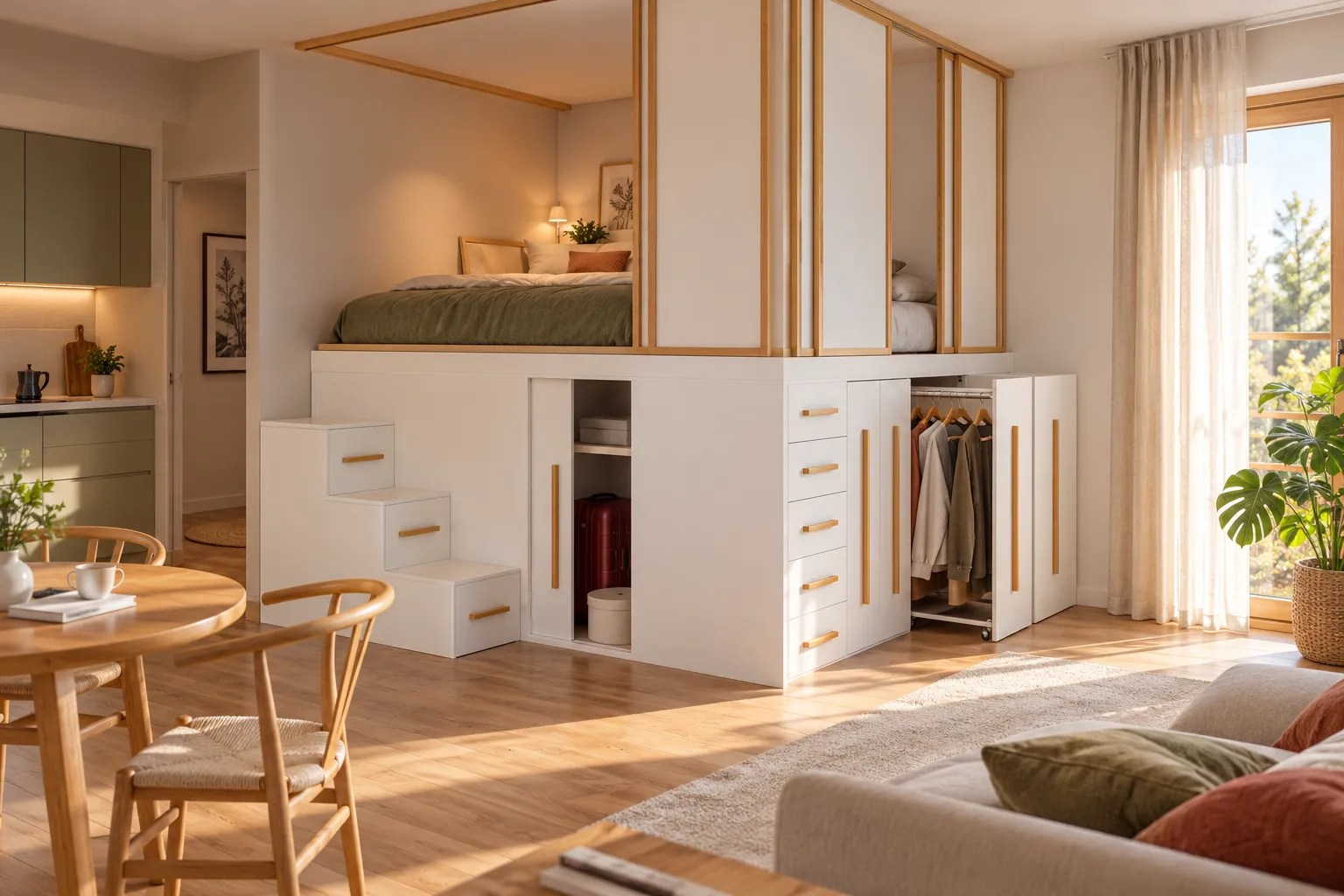
A space-saving bed is a structure designed to minimize the impact of the sleeping area on the room or to use the same space for multiple purposes. This does not necessarily mean a “bed that disappears”: a bed can also be space-saving because it incorporates a closet, contains drawers, hides a second bed, or is raised to make the space underneath usable. This distinction is important because there are many types of space-saving beds, each with very different operating principles. A fold-away bed frees up floor space when folded away. A pull-out bed utilizes the space beneath another structure. A bunk bed stacks multiple sleeping areas on top of one another. A storage bed makes use of the space immediately beneath the mattress base. Finally, a loft bed can completely transform the space below into a closet, dresser, bookshelf, study area, or walk-in closet.
So there is no single “best” solution: the choice depends on how much space we want to free up and what function we want to add. A children’s room for two kids has different needs than a studio apartment, a small master bedroom, or a home office that occasionally doubles as a guest room. That’s why it makes sense to categorize space-saving beds not only by their shape but, above all, by how they utilize space.
1. What really makes a bed “space-saving”?
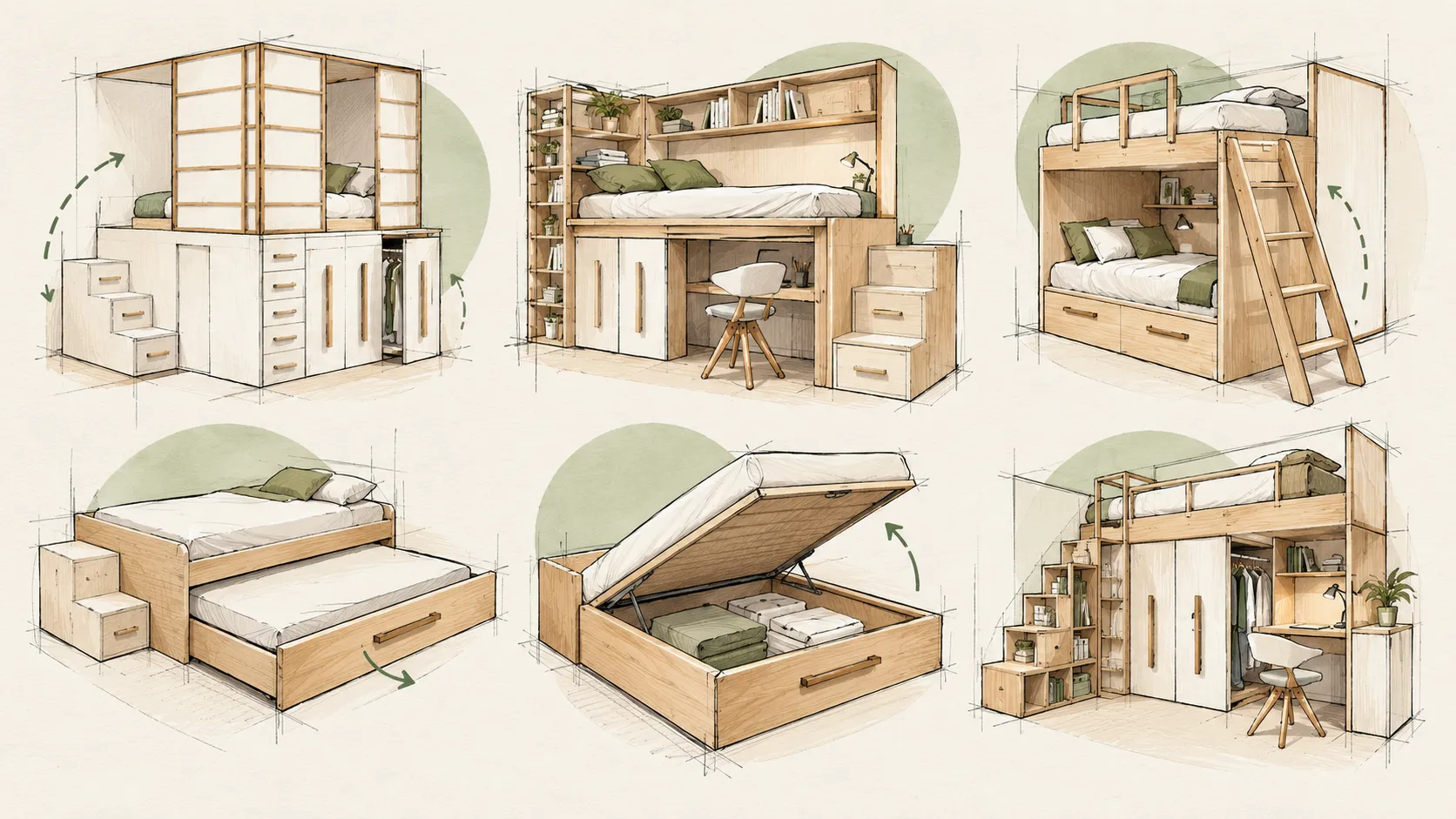
From a design perspective, a bed can save space in four main ways: by tucking away, sliding, combining functions, or incorporating storage.
The first example is that of fold-away beds. The bed frame and mattress are stowed away when not in use, typically inside a piece of furniture, a wall unit, or under another structure. This way, the space occupied at night becomes usable again during the day.
The second principle is pull-out functionality. A bed can remain hidden beneath another bed or under a platform and slide out only when it needs to be used. This is a particularly useful solution when a second sleeping space is needed or when the same room needs to serve different purposes throughout the day.
The third principle is vertical development. Loft beds, mezzanines, and bunk beds make use of the room’s height rather than spreading all functions out across the floor. It is one of the most effective strategies for children’s bedrooms and very compact spaces.
Finally, there is built-in storage. The space under the bed can serve as a simple storage compartment, but it can also be a chest of drawers, a set of pull-out drawers, or a full-fledged wardrobe.
It is precisely this fourth interpretation that characterizes most of SpazioBed’s space-saving double bedrooms: instead of viewing the bed merely as an unavoidable obstacle, the design also makes use of the space beneath the sleeping surface. This concept is explored in greater depth in the article dedicated to storage beds, where we distinguish between the classic storage compartment and systems featuring drawers, roll-out units, and independently accessible cabinets.
2. Murphy beds and pull-out beds: when the bed appears only when needed
The Murphy bed is probably the type most immediately associated with the term “space-saving.” In the vertical model , the structure rotates on the short side and folds against a wall. In the horizontal model, however, the movement occurs along the long side and requires less vertical space. These solutions are particularly useful when the surface area occupied by the bed must be completely recovered during the day : studios, guest rooms, living rooms, and multifunctional studies are the most common examples.
Another variation is the pull-out bed. It doesn’t fold up against a wall; instead, it slides horizontally out from underneath another piece of furniture. In children’s bedrooms, it can serve as a second or third bed hidden beneath the main one. Children’s bedrooms with pull-out beds use this very principle to increase the number of available sleeping spots without keeping all the mattresses permanently exposed. The same logic can be applied more radically to adult living spaces. In the raised study with a hidden bed underneath, for example, the double bed slides out from beneath a walk-on platform. A study area can remain permanently in place above: the desk, chair, and other items do not need to be moved when the bed is pulled out.
The SpazioBed Platform Bed applies the same concept with a raised platform of about 60 cm and a pull-out double bed that disappears completely beneath the structure during the day. This design is particularly appealing because it doesn’t require converting another piece of furniture. In the article on alternatives to the sofa bed, we saw how a freestanding bed hidden beneath a study area can eliminate the classic trade-off between seating comfort and sleep quality.
In general, therefore, fold-down beds and pull-out beds are recommended when the priority is to free up floor space during part of the day.
3. High beds and loft beds: You can create another room under the bed
The loft bed It uses a completely different principle: it doesn’t disappear or get moved. It remains available at all times, but is raised to make the lower volume usable. It is one of the most versatile types because the height can be adjusted based on the room and the purpose for which it will be used. With a relatively small increase in height, you can create large drawers and chest drawers. The Chests of Drawers For example, they transform the space under the bed into a real chest of drawers that can be used every day. By increasing the depth and adding pull-out compartments, you can instead use storage carts or coat racks. In the Rooms with carts, the storage extends straight out from the bed and can be organized using coat hooks or shelves. The next step is to create a a real under-bed storage cabinet. The Rooms with a closet underneath They use the lower section for coat hooks, shelves, drawers, and doors. This way, the bed and the wardrobe occupy the same floor space in the room but on two different levels.
SpazioBed applies this principle to both single and double beds. The configuration can be further enhanced with bookshelves, storage ladders, or side compartments. The “Bedrooms with Bookshelves,” for example, also integrate this feature into the structure. In children’s bedrooms, the same concept can become even more sophisticated. Children’s bedrooms with walk-in closets use vertical space to create a true wardrobe area beneath the sleeping surface. Other configurations incorporate desks, bookcases, and rolling cabinets. For those interested in a more technical look at this product line, Cinius describes its space-saving beds for adults as tall, customizable structures with drawers, rolling cabinets, and wardrobes underneath.
It is also important to consider safety. For loft beds and bunk beds that fall within its scope, the UNI EN 747-1:2024 standard establishes requirements for safety, strength, and durability. Therefore, the design must take into account not only storage capacity and overall dimensions, but also access, guardrails, stability, and intended use.
4. Bunk beds, staggered beds, and multiple-bed configurations: save space while increasing the number of sleeping spots
Another large category of space-saving beds isn’t designed to provide storage, but to accommodate multiple sleeping spots in the same room. The best-known example is the bunk bed. By stacking two sleeping surfaces, you use almost the same floor space as a single bed. Children’s bedrooms with bunk beds can also incorporate ladders, drawers, and additional storage elements.
However, beds don’t always have to be perfectly stacked. Offset configurations allow you to shift the two levels sideways, creating space under the upper bed for closets, dressers, or bookshelves. The Zig Zag SpazioBed solutions are based largely on this concept: two beds can be arranged at different heights and positions, while the space below is used for wardrobes and storage. Some configurations also include a third pull-out bed. There are also corner solutions, which are useful when the room’s dimensions don’t allow for a layout running the entire length of a wall. Two beds are arranged along perpendicular walls, and the remaining space can be filled with closets or storage units.
The 2- or 3-Bed Children’s Rooms incorporate precisely these different strategies: bunk beds, staggered arrangements, pull-out beds, and combinations with built-in closets. The principle is important: a space-saving bed doesn’t necessarily have to take up less space than the mattress itself. It can be space-saving because it combines, within the same volume, functions that would normally require more furniture or more floor space. This is what distinguishes a simple compact bed from a true space-saving system designed specifically for the room.
5. What type of space-saving bed should you choose?
The choice depends mainly on what you want to achieve.
If the goal is to completely free up the floor space during the day, the most logical solution is a fold-away or pull-out bed under a platform.
If you need an extra sleeping spot, a pull-out bed under another bed may be sufficient; however, for two or three people who share the room on a regular basis, bunk beds and staggered configurations become more appealing.
If storage is the real issue, a loft bed offers more possibilities: drawers, deep drawers, rolling storage units, bookshelves, and closets can all be integrated into the same structure. This is the product line on which SpazioBed focuses a large part of its range.
If the room needs to serve two different functions—such as a study and a guest room—a raised structure with a hidden bed allows you to maintain both functions without having to take it apart and reassemble it every day.
For a small bedroom, it can be helpful to start with the Small Children’s Bedrooms, while those who are designing an adult bedroom or an open-concept space may want to consider the Studio rooms and the solutions Space-Saving Home Office and Living Room. For beds intended for adults, the UNI EN 1725:2024 serves as one of the technical references for requirements regarding Safety, Strength, and Durability of Beds within its scope of application. In the case of tall structures, castles, or multifunctional systems, other relevant standards may also apply, depending on the configuration.
Custom design is particularly useful because it allows you to start not with a standard model, but with the room’s actual measurements: ceiling height, the location of doors and windows, necessary walkways, and the amount of storage needed. This is also why there is no single answer to the question, “What is the best space-saving bed?” A child’s bedroom, a room for two siblings, a studio apartment, and a guest room all require completely different solutions.
The main types of space-saving beds can therefore be grouped into five broad categories: fold-away beds, pull-out beds, storage beds, high beds with under-bed storage, and bunk beds or staggered beds. SpazioBed focuses primarily on the concept of custom-made loft beds: rather than necessarily hiding the sleeping area, it utilizes the space beneath the mattress to create closets, drawers, storage carts, bookshelves, and other functional elements. However, this category is also complemented by pull-out beds, bunk beds, corner configurations, and fold-away systems for home offices and living rooms.
The right starting point, therefore, is not to choose a type of bed simply because it “takes up little space,” but to determine which function of the room we want to restore. Once that has been defined, the space-saving bed can become the centerpiece of the entire design rather than its main obstacle.