
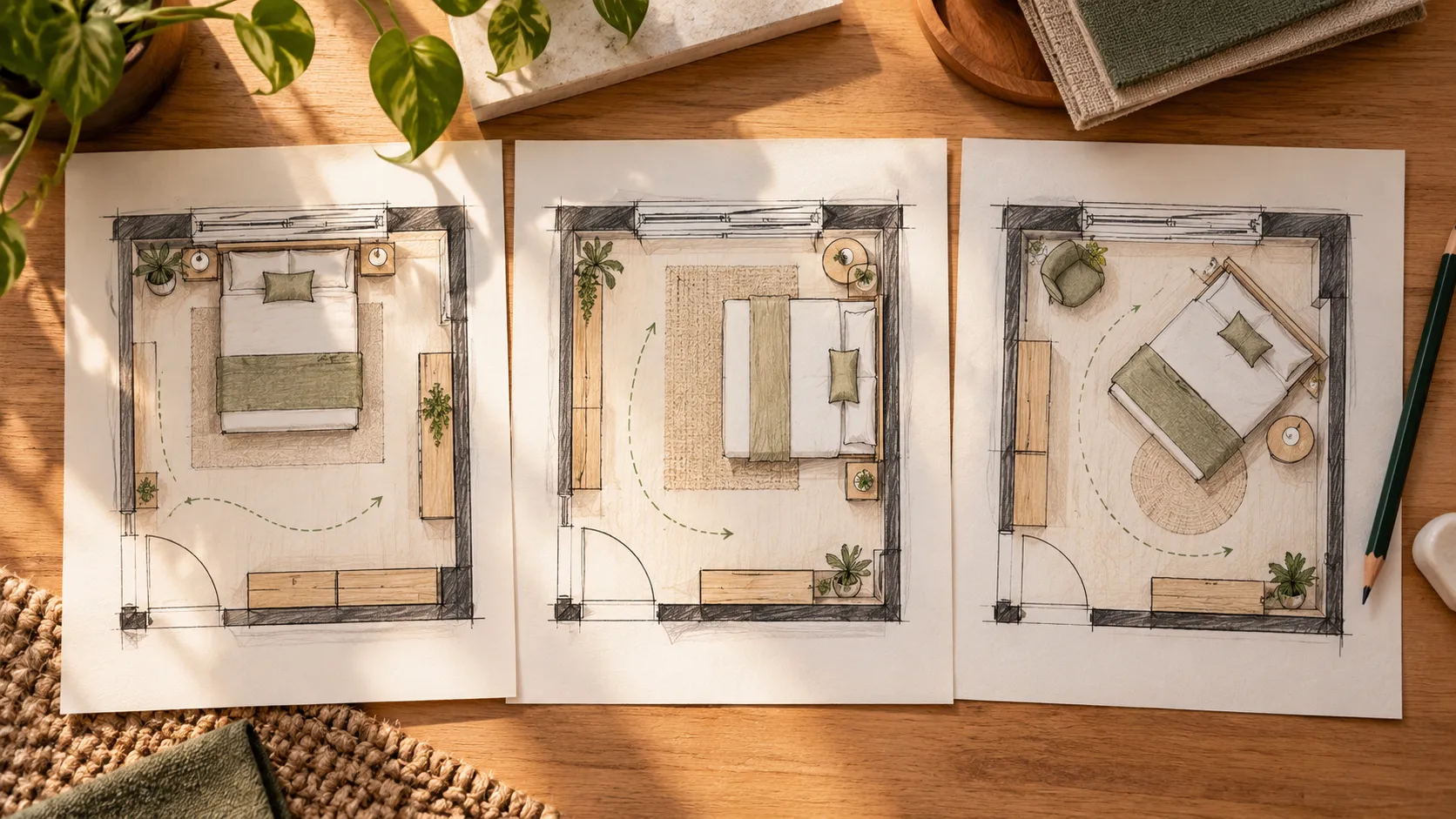
The placement of the bed in the bedroom should be chosen based on the room’s actual layout, not just on aesthetics. Doors, windows, closets, radiators, electrical outlets, and walkways all determine whether a layout will actually be convenient for daily life. As a general rule, it’s best to place the headboard against a solid, stable wall, keep the main walkways clear, and make sure the bed doesn’t block the opening of doors, windows, drawers, or closets. If the room allows it, it’s also helpful to be able to comfortably reach both sides of a double bed.
However, there is no one-size-fits-all solution. A square room allows for different design choices than a long, narrow room; a double bed requires a different layout than a single bed; and a tall SpazioBed also introduces a different design approach because a closet, drawers, bookshelves, or rolling cabinets can be placed beneath the sleeping area. For this reason, the best placement is one that successfully combines comfort, ease of movement, light, and the use of other furniture.
How to Choose the Right Wall for Your Bed?
The first thing to determine is which wall will serve as the headboard wall. Whenever possible, a solid wall is generally the simplest solution: it allows for better arrangement of the bed, nightstands, or side tables, and provides greater flexibility in dealing with windows. Placing the headboard directly under a window isn’t necessarily a complete mistake, but it does introduce some complications. You’ll need to check the window’s opening mechanism, curtains, any radiators, drafts, and accessibility for cleaning. If there’s another suitable wall, it’s often easier to position the window to the side of the bed. The door must also be taken into account. The bed should not obstruct the door’s opening nor be positioned in a way that forces you to take unnatural paths to cross the room. A good layout allows you to enter and reach the sleeping area without constantly having to navigate around furniture or the corners of the bed.
When designing a master bedroom, you must also consider the total width of the bed and the side tables. In our in-depth guide on the space required for a bed and nightstands, we analyzed the dimensions of the sleeping area and the walkways that need to be planned. In a small bedroom, however, you may need to sacrifice symmetry. One side may have more clearance than the other, or the bed may be placed closer to one wall. The important thing is that the choice is a conscious one and that the main functions remain accessible.
Where Should You Not Place the Bed?
Rather than talking about absolute prohibitions, it’s helpful to identify the locations that tend to create practical problems. You should avoid placing the bed in front of a door or a cabinet door that needs to open, as well as too close to a closet if there isn’t enough space to use the doors and drawers. In front of a wardrobe, it’s best to leave a clear area that allows both for passage and for opening the cabinet. Placing the bed against a radiator is also generally impractical: it interferes with heat distribution and makes it harder to access the heating system. The same applies to outlets, light switches, or maintenance access points, which should not be completely hidden by the bed frame.
A spot under a window, on the other hand, should be evaluated on a case-by-case basis. If it’s the only possible solution, it can work—as long as the window frame and curtains remain accessible and there are no issues with drafts or heating. In particularly narrow rooms, the wall that seems like the most natural choice isn’t always the best. In the article on long, narrow bedrooms, for example, we saw how placing the headboard against the short wall can, in some cases, rebalance the room and improve traffic flow. Before moving the bed, it’s therefore a good idea to also sketch out the dimensions of open spaces: doors, cabinet doors, drawers, windows, and chairs take up more space when in use than what’s shown on a simple floor plan.
How much space should you leave around the bed and the closet?
A good bed placement doesn’t depend solely on where the headboard is located. What matters most is the space around it. On either side of a double bed, when the size of the room allows, it’s helpful to leave enough space to get in and out comfortably, make the bed, and reach any nightstands. Not all rooms allow for the same amount of space on both sides: in small rooms, you can also work with an asymmetrical layout.
When placing furniture in front of a closet, however, you need to consider both the depth of the clearance and the type of door opening. Sliding doors require less front space than hinged doors, while drawers and pull-out units must be able to be pulled out completely. As a design guideline, a clear space of about 70–90 cm between the bed and the closet generally allows for more convenient use, when the room’s dimensions permit.
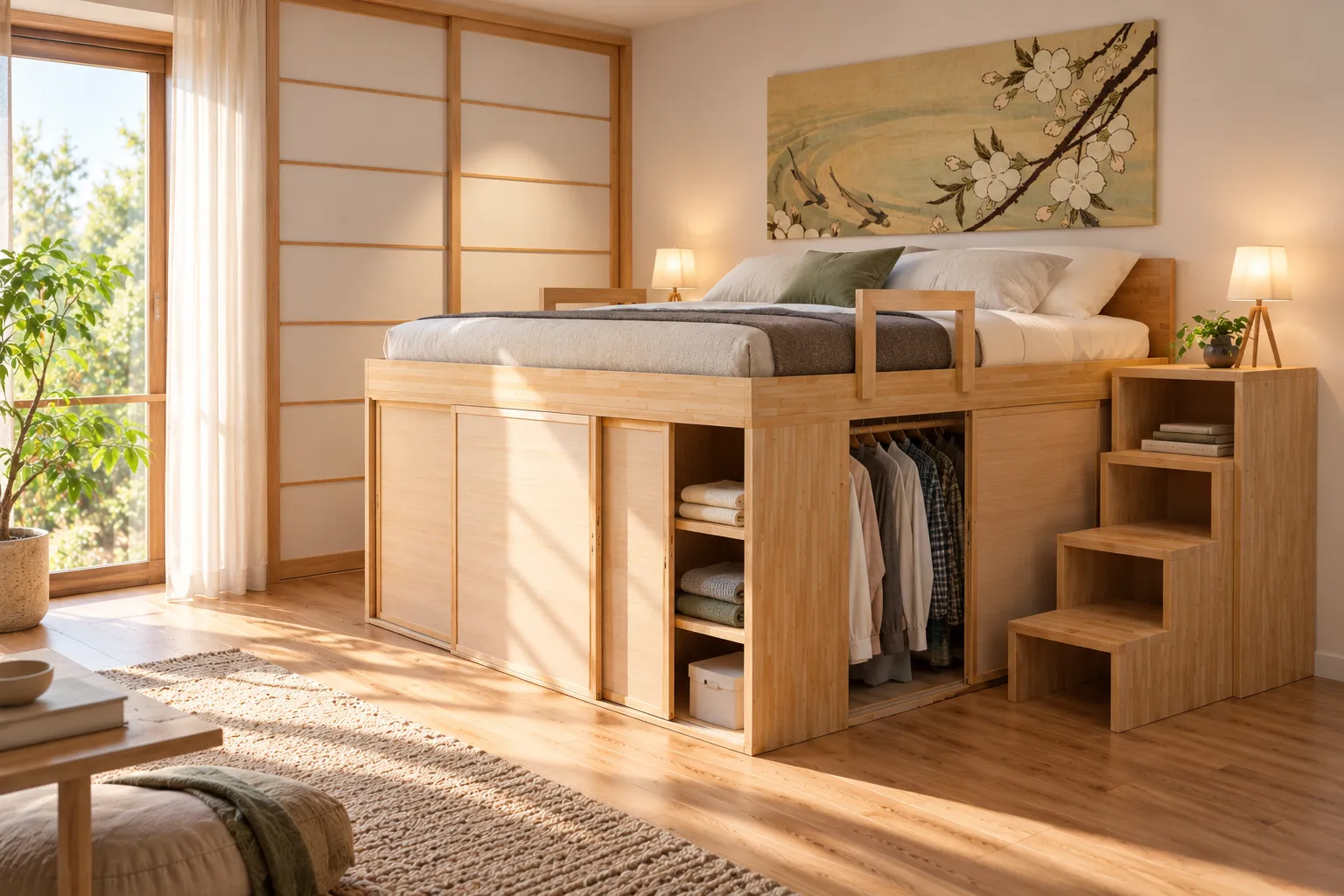
This is precisely why, in small bedrooms, the placement of the bed and the closet shouldn’t be decided separately. The guide on how to arrange furniture in a small bedroom explores the relationship between the bed, storage, and traffic flow. With SpazioBed Double Bedrooms, this relationship can change even further. By raising the bed, some of the storage can be moved beneath the sleeping area: wardrobes, drawers, bookshelves, or rolling units do not necessarily require a second large wall. The bed’s position can therefore be chosen not only based on where the mattress fits, but by considering the entire three-dimensional layout. This approach is particularly useful when furnishing a small bedroom without cluttering the perimeter with separate pieces of furniture.
How should a bed be positioned according to Feng Shui?
In addition to design criteria, many people seek guidance on bed placement according to Feng Shui. It’s worth noting that Feng Shui is part of Chinese tradition and offers symbolic and energetic principles for organizing spaces; it should therefore not be confused with building codes or scientific guidelines on sleep. One of the best-known concepts is the so-called “command position”: from the bed, you should be able to see the door without being directly aligned with it. The headboard should preferably rest against a solid wall, which is seen as a source of stability and protection.
This tradition also gives rise to a common question: Why not place the bed with its foot at the door? In Feng Shui, this arrangement is often avoided because it symbolically resembles the way, according to some Chinese funeral traditions, the body is carried out of the room. It is therefore a cultural and symbolic consideration, not a technical issue with the bed itself.
The recommended direction for the head also varies depending on the school of Feng Shui. Recommendations may point north, east, or in other directions, depending on the individual and the environment. However, there is no scientifically proven cardinal direction that is universally considered best for sleeping. From a practical standpoint, factors such as light, noise, temperature, ventilation, and mattress comfort are more important. For this reason, the orientation can be chosen freely based on the floor plan and, if desired, later interpreted according to Feng Shui principles. This avoids a common mistake: sacrificing a functional layout, blocking a closet, or narrowing a passageway just to strictly adhere to a cardinal direction.
Bedroom Bed Position: A Checklist Before Deciding
To correctly choose the position of the bed in the bedroom, it can be useful to proceed in a precise order.
1. Identify the walls that can actually be used. Exclude those significantly affected by doors, windows, radiators, or other structural elements.
2. Draw the bed to scale. Take into account the frame and headboard, not just the size of the mattress.
3. Check the layout. Imagine walking into the room, reaching both sides of the bed, opening the closet, and using all the drawers.
4. Check the light and the window. The bed should not make it difficult to open, close, or clean the window frames.
5. Only then should you consider aesthetics and Feng Shui. Once you’ve identified two or three truly functional layouts, you can choose the one that offers the best view when you enter the room or that best aligns with your personal preferences.
The available space naturally imposes certain limitations. For a room intended for two people, it’s also helpful to know the minimum size of a double bedroom, while in extremely compact rooms, the layout must be planned centimeter by centimeter. Finally, in studio apartments, the placement of the bed can influence the entire living space. In these cases, you’re not just designing a sleeping area: you also need to ensure that the living area, storage, and walkways remain usable. The bottom line is simple: functionality comes first, followed by the perception of space, and finally, aesthetic or symbolic preferences. The ideal position for the bed is one that allows you to sleep comfortably without disrupting the flow of the surrounding space.