
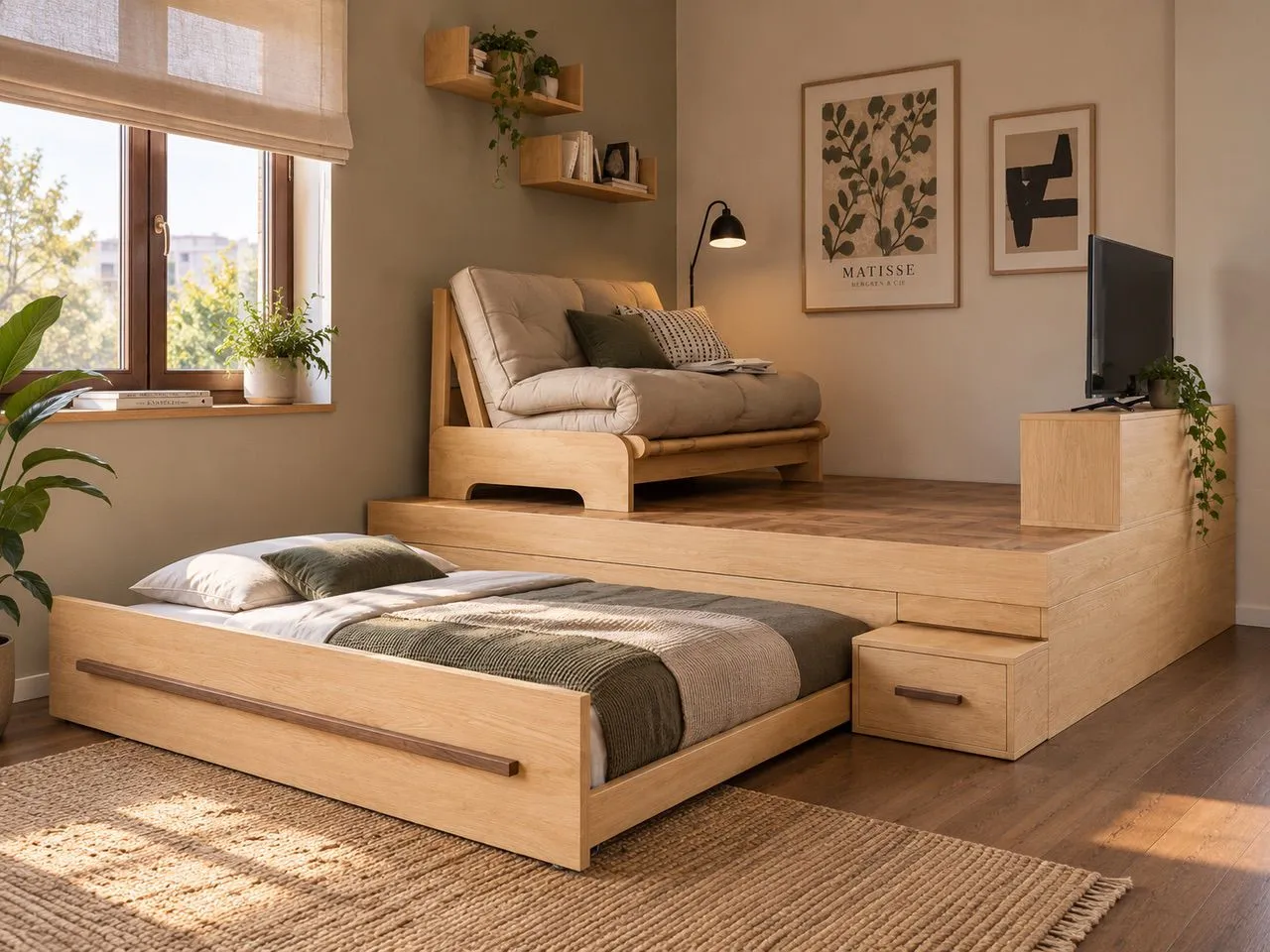
There are many alternatives to a sofa bed, and they don’t necessarily require replacing your sofa with another piece of convertible furniture. Daybeds, sleeper chairs, futons, air mattresses, and fold-away beds each meet different needs, but the most interesting option may be yet another: completely separating the “sofa” function from the “bed” function. The traditional sofa bed, in fact, stems from a compromise: the same piece of furniture must serve as comfortable seating during the day and transform into a sleeping surface at night. In some spaces, this solution works very well; in others—especially in studio apartments or multifunctional rooms—it may be more effective to keep the living room truly usable and find a different space for the bed. This is precisely the principle behind some SpazioBed solutions: instead of hiding the bed inside the sofa, it can be tucked away under a study area or beneath a raised structure, making use of vertical space.
First question: Do you need the bed every night, or just for guests?
Before choosing among the various alternatives to a sofa bed, it’s helpful to determine how often the sleeping space will be used. This is probably the most important factor, because a solution that’s perfect for a guest who stays over three times a year can become impractical if used every night. For very occasional use, a good-quality air mattress, a fold-out futon, or a convertible ottoman may suffice. They take up little space when not in use and allow you to quickly create an extra sleeping spot. For periodic use, daybeds, bench beds, and convertible armchairs become more appealing options. The bed is easier to set up, and the piece of furniture remains useful even during the day.
If, on the other hand, the sleeping space needs to be used frequently, it’s worth considering a structure capable of accommodating a real bed frame and a real mattress, without relying on the sofa’s seating area. In this case, pull-out beds and fold-away beds come into play. An editorial overview of contemporary alternatives is also available in Idealista’s in-depth article on alternatives to sofa beds, which distinguishes between fold-away beds, convertible armchairs, bench beds, and temporary solutions. Living Corriere also analyzes daybeds, pull-out beds, fold-down beds, pouf beds, futons, and modular systems. The choice should therefore be based on frequency of use and not just on the amount of available space.
Daybeds, futons, sleeper chairs, and fold-away beds: what’s the difference?
Among the simplest options is the daybed: a piece of furniture that resembles a bench or a small sofa but is essentially designed as a bed. With the addition of pillows, it can be used during the day for sitting or relaxing, and when needed, it’s ready for sleeping. The futon follows an even more minimalist approach. It can be folded or stored away during the day and unfolded only when needed. It’s a flexible choice, but it requires setting up and then clearing the space each time. Convertible armchairs and sleeper ottomans further reduce the space they take up. They’re a good option for a single guest or occasional use, but they don’t address the need for a real double bed.
The fold-away bed, on the other hand, falls into a different category: when in use, it is a full-fledged bed; when not needed, the space it occupies can be repurposed for another function. The best-known system is the vertical fold-down bed integrated into a wall unit, but it is not the only way to conceal a sleeping area. In fact, there is also a horizontal fold-away option: the bed can slide under a platform or another structure. This design avoids taking up a large vertical wall and allows the space above it to remain permanently usable. This is where the alternative to the sofa bed becomes particularly interesting: instead of designing a piece of furniture that changes function every night, you can design two independent functions within the same room space.
SpazioBed Raised Study: The bed isn’t in the sofa—it’s hidden under the desk
The SpazioBed Raised Study with a hidden bed operates on a completely different principle than a sofa bed. The upper section is a walk-on platform where you can set up a real study area, complete with a desk, chair, and bookshelf. This workspace remains permanently assembled and ready for use: there’s no need to remove the computer, move books, or dismantle the platform when it’s time to sleep. Beneath the platform is the bed. The StudioLetto’s pull-out bed slides out only when needed. During the day, it retracts under the platform, leaving the lower part of the room unobstructed.
Compared to a sofa bed, therefore, the very concept of convertibility changes:
- The sofa must not be converted into a bed;
- the study area must not be dismantled;
- The bed has its own independent frame;
- The conversion is accomplished simply by pulling the bed out or pushing it back in;
- Two functions occupy the same space on different levels.
This makes the solution particularly appealing in a studio apartment, in a home office that occasionally needs to accommodate a guest, or in a room that must remain entirely dedicated to other activities during the day. In the article on the raised study with a hidden bed, we explored this very arrangement of space: the work area remains above, while the sleeping area appears only when actually needed. It is therefore not a matter of building a “better sofa bed,” but of eliminating the compromise between a sofa and a bed. The living room can have whatever sofa you want; the bed is handled separately.
More Than Just a Hidden Bed: Rethinking the Entire Living Space Vertically
The concept can be extended to the entire living room. SpazioBed’s space-saving Studio and Living Room solutions use raised platforms to distribute different functions across two levels instead of placing them all on the same floor. The Raised Living Room, for example, places the relaxation area on the upper platform and uses the space below for storage. The Raised Living Room Barcelona applies this logic to the living area with a closet hidden beneath the platform. This solution does not directly replace the sofa bed with another sleeping surface; however, it helps illustrate an important principle. When a home is small, it is not necessary for every piece of furniture to be multifunctional. Instead, you can adjust how functions are distributed within the space.
It’s the same reasoning that makes the bed hidden beneath the desk so appealing: you don’t have to sacrifice the quality of the sofa to create a bed, nor do you have to sacrifice the bed to create a place to sit. The two functions can remain separate. In studio apartments, this approach is particularly effective, because the living room, bedroom, closet, and workspace often have to coexist in the same room. The guide “Living Well in a Studio Apartment: 7 Space-Saving Solutions” brings together various strategies based precisely on the overlapping or integration of functions. Even for those who prefer a more minimalist living room, thinking this way can be helpful. In our in-depth lookat minimalist living room design, we saw how reducing the number of furniture pieces can increase the flexibility of the space, especially in compact rooms.
What’s the best alternative to a sofa bed?
The best solution depends on how many people need to sleep there, how often, and what the room is used for during the day. If you only need an occasional sleeping spot for one person, a sleeper chair, a daybed, or a futon may be sufficient. They take up relatively little space and require minimal design investment. If guests are very occasional and the top priority is freeing up space, even a modern air mattress can make sense: when it’s not needed, it’s simply put away.
If, on the other hand, you want to ensure a real and frequently used sleeping space, a fold-away or pull-out bed generally becomes a more appealing option. In particular, when the room needs to continue serving a specific purpose during the day—as a study, living room, or home office—it’s worth considering systems in which the bed folds away without requiring you to rearrange the other furniture. The SpazioBed raised study was created precisely to meet this need: the upper level remains a study even when the bed is pulled out below. It is therefore one of the most radical alternatives to the sofa bed, because it doesn’t try to improve the sofa’s mechanism—it eliminates the need to use it as a bed altogether.
When designing a small space, it’s therefore a good idea to ask yourself not only “Where can I fit an extra bed?” but also “What function can I layer vertically within the sleeping area?” This is the step that transforms a simple solution for guests into a true space-saving design: not adding another convertible piece of furniture, but allowing two spaces to coexist within the same volume without requiring them to be used at the same time.