
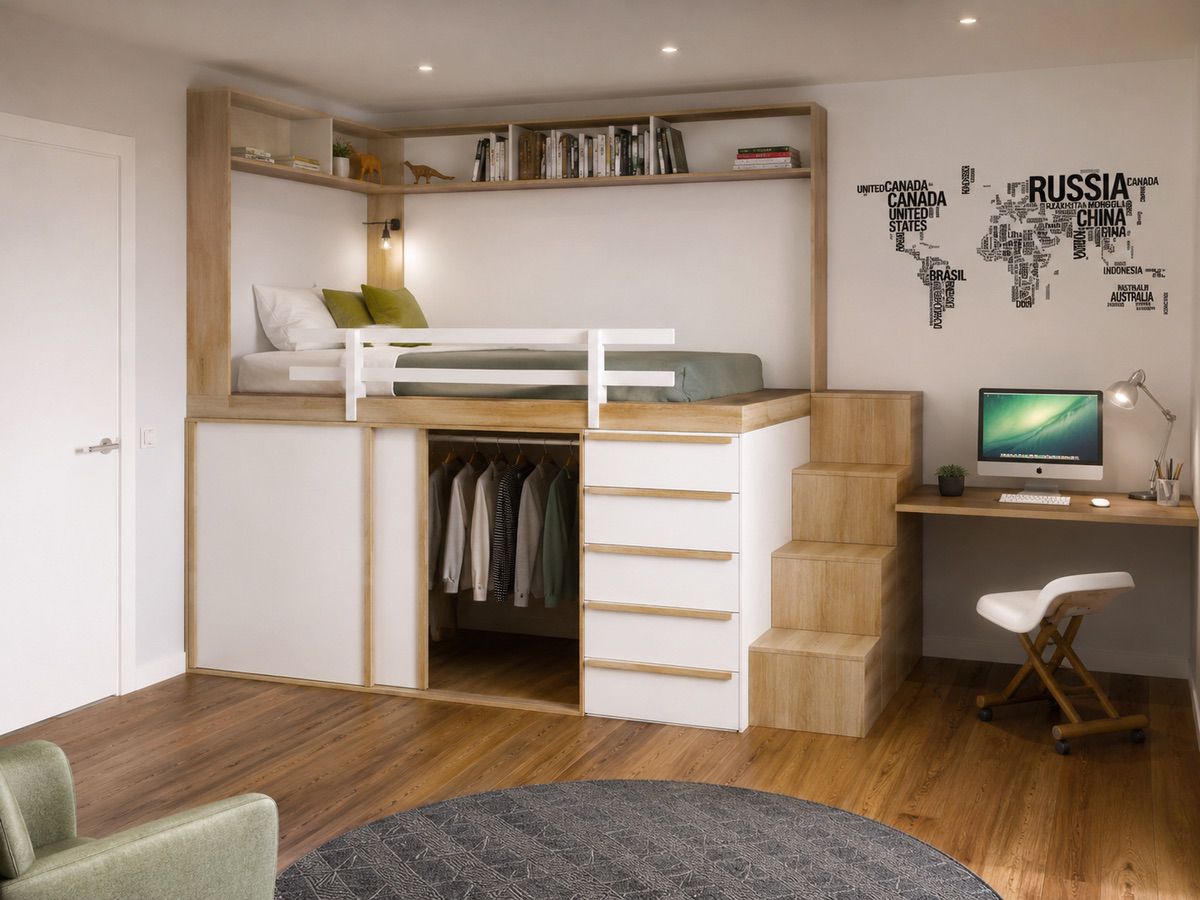
When a room is small, every inch counts. Maximizing space in a child’s bedroom isn’t just about choosing narrower furniture; it’s about rethinking the layout in a smart way: where to sleep, where to study, where to store clothes and toys, and where to leave room to move around. The risk in compact bedrooms is filling every wall with wardrobes, a bed, a desk, and separate storage units, resulting in a cramped, impractical, and difficult-to-live-in room. The best solution is often the opposite: concentrating multiple functions into a few well-designed pieces, making use of height, depth, and normally unused spaces.
That’s why small, space-saving children’s rooms shouldn’t be thought of as scaled-down versions of a traditional bedroom, but rather as spaces designed around the actual habits of children and teenagers.
1. Start with the actual measurements, not just the square footage
Before choosing furniture, it’s a good idea to measure the room carefully: width, length, height, and the locations of doors, windows, radiators, outlets, and light fixtures. A bedroom may have enough floor space on paper, but it can be difficult to furnish if it’s narrow, long, irregularly shaped, or interrupted by openings. In Italy, as a general guideline, a single bedroom should be at least 9 square meters, while a bedroom for two people should be at least 14 square meters. These figures, however, represent a minimum threshold: they do not automatically guarantee that the room will be comfortable. A 9-square-meter bedroom, for example, can work very well if the furniture is designed to maximize vertical space; conversely, it can become uncomfortable if every function takes up floor space. To maximize space in a bedroom, you must therefore consider a practical question: how much free space remains after placing the bed, storage units, and study area?
2. Make the most of the vertical space with a high bed or a loft bed
One of the most effective ways to free up floor space is to raise the bed. The bed is the bulkiest piece of furniture in the bedroom, as it takes up a significant portion of the floor for many hours when it’s not in use. Raising it allows you to transform the space below into a closet, walk-in closet, storage unit, bookshelf, second bed, or play area. SpazioBed solutions are based precisely on this principle: the bed is not an isolated element but becomes part of a larger structure. Depending on the configuration, the space under the bed can accommodate dressers, hanging racks, storage compartments, bookshelf modules, or wardrobe units.
For a room intended for a single child or teenager, you might consider a space-saving single-bed bedroom set, especially if the goal is to keep the center of the room clear without sacrificing storage or a study area.
3. Use the pull-out bed if the bedroom is shared or needs to accommodate
If the bedroom needs to accommodate two children, or if you need an extra bed for guests, a pull-out bed is a very practical solution. During the day, it stays hidden under the main bed frame, while at night it can be pulled out only when needed. This setup avoids having two beds that are always visible and take up space. In a small room, the difference is huge: during the day, the bedroom stays more open, easier to tidy up, and better suited for play or study.
Children’s bedrooms with pull-out beds are particularly appealing when you’re looking for a flexible solution that works for both everyday use and occasional needs. In some configurations, the pull-out bed can also be combined with chest of drawers, storage ladders, or pull-out desks.

4. Consider bunk beds and staggered arrangements for two or three beds
When you need to accommodate two or three people, the challenge isn’t just “where to put the beds,” but how to prevent the entire room from becoming a sleeping area. In these cases, vertical solutions are often the most effective. Classic bunk beds help stack two identical functions, but more advanced configurations can do more: staggered beds, corner beds, tall structures with a lower second bed, zigzag modules, and built-in wardrobes and bookshelves. This way, you save space without making the room feel cramped.
For a shared bedroom, it makes sense to consider space-saving bedroom sets with 2 or 3 beds, and, if the ceiling height allows, even bedroom sets with bunk beds. If you have three children, however, space-saving 3-bed bedroom sets allow you to consider more complex layouts, avoiding the need to fill the entire floor with traditional beds.
5. Turn stairs, bases, and substructures into storage spaces
In a small bedroom, every piece of furniture should serve more than one purpose. A ladder, for example, shouldn’t just be for climbing—it can include drawers, open compartments, or small storage spaces. The same goes for the bed base, the sides of the frame, the back, the headboard, and the side panels. This approach reduces the need for additional furniture. Fewer dressers, fewer nightstands, fewer separate storage units: more organization and more open space. The benefit isn’t just aesthetic—it’s practical. A bedroom with built-in storage is easier to use every day, because clothes, toys, books, and school supplies all have a specific place.
6. If you don’t have a closet, consider a storage compartment under the bed
One of the most common challenges in small bedrooms is finding space for a wardrobe. A traditional wardrobe can take up an entire wall and significantly reduce the amount of space available for movement. For this reason, when the room’s height allows it, it can be helpful to place the bed on a loft and create storage space underneath.
Bedrooms with a walk-in closet under the bed are designed to meet this very need: the space occupied by the bed is also used as storage. This eliminates the need to add a bulky wardrobe elsewhere in the room. It’s a particularly useful solution for older kids, who need more space for clothes, shoes, backpacks, sports gear, and personal items.
7. Clear the center of the room
A simple way to tell if a child’s bedroom is well-organized is to look at the center of the room. If it remains clear, the room appears larger, is easier to keep clean, and can accommodate more activities. If, on the other hand, the center is cluttered with furniture, chairs, storage units, and narrow pathways, even a room that isn’t particularly small can seem cluttered. To free up space in a child’s bedroom, therefore, it’s best to move the main functions to the walls and up high: a loft bed, built-in wardrobe, pull-out or suspended desk, bridge-style bookshelves, under-bed storage, and pull-out carts. The goal is to create a room that isn’t just furnished, but truly livable.
Is standard furniture better, or a custom solution?
Standard furniture can work well when a room has regular proportions and generous dimensions. In small bedrooms, however, it often leaves unused space: a few centimeters between the wardrobe and the wall, depths that are hard to utilize, dead corners, and passageways that are too narrow. A custom solution, on the other hand, allows you to start with the actual room and build a layout that fits its dimensions perfectly. That’s why SpazioBed kids’ bedrooms aren’t designed as rigid products, but as configurations that adapt to different spaces, heights, numbers of beds, and storage needs.
Ultimately, maximizing space in a child’s bedroom means better design. It’s not enough to simply add storage or choose light colors: you need to understand which functions need to coexist in the room and find the smartest way to integrate them. Loft beds, pull-out beds, under-bed storage, storage ladders, and modular units can transform even a small bedroom into a tidy, practical space that grows with those who live there.