

Dividing a small bedroom for two doesn’t necessarily mean building a wall in the middle of the room. In most cases—especially when space is limited—the best solution is to create two distinct, organized, and personal areas without blocking light, obstructing passage, or restricting freedom of movement. When two children or teens share a room, the challenge isn’t just about having two beds. Each needs their own little space: a place to sleep, a spot for their clothes, a personal storage unit, a lamp by the bed, a shelf, a desk, or at least a dedicated surface.
That’s why a shared bedroom should be designed as a combination of functions, not just as a room with two mattresses. Children’s bedrooms allow you to think exactly this way: not just dividing the space, but organizing it so that both children can make the most of it.
Rule #1: Separate functions, not just the room
The most effective division isn’t always a physical one. In a small bedroom, a full-height partition wall can block light, make the room feel narrower, and create two impractical spaces. It’s often better to divide the room based on function: sleeping area, storage, study, play area, and walkway. For example, you can create two distinct sleeping areas even without separating them with a wall. Simply use different heights, staggered beds, storage units, low bookcases, coordinating colors, or small personal spaces. The goal is to make each child or teenager feel like they have their own space, even if the room remains a single space. This approach is particularly useful when children are of different ages. A young child may need more play space, while an older child may prefer a study area and personal storage. The division should therefore reflect the family’s actual habits.
Separate beds or built-in beds: Which option should you choose?
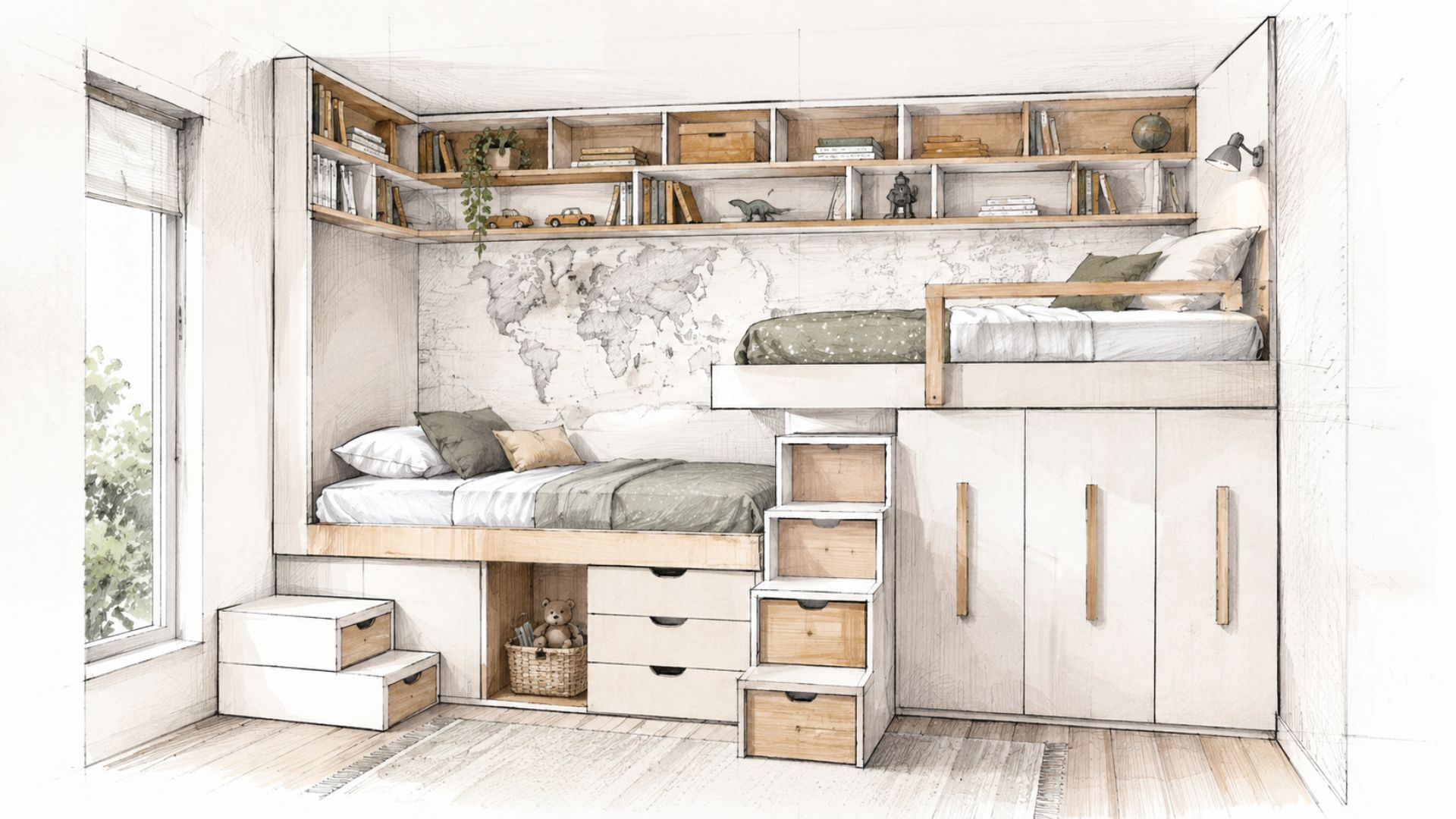
The choice of beds has a huge impact on how you can divide up the bedroom. Two floor-level beds, placed parallel to each other or in a row, create a simple division but take up a lot of floor space. They can work in fairly spacious rooms, but in small bedrooms they risk leaving little room for closets, desks, and walkways. A more advanced solution is to use beds at different heights, staggered beds, bunk beds, or configurations with one high bed and one low bed. This way, the room is divided not only horizontally but also vertically. The space above and below the bed becomes part of the design. The 2- or 3-Bed Children’s Rooms are designed specifically for situations where multiple sleeping areas need to coexist with storage, organization, and clear pathways. In a room for two, this allows you to create personal zones without turning the room into two tiny bedrooms.
Use cabinets, bookshelves, and storage units as light room dividers
A smart way to divide a small bedroom for two is to use furniture as room dividers. A low bookcase, a storage unit, a dresser, or a small tall piece of furniture can create a visual separation without completely blocking the light. This solution works well when you want to give the two children their own space without making the room feel cluttered. A room divider can separate the beds, delineate two study areas, or create a small buffer between the bed and the play area. Be mindful, however, of the depth of the furniture. In a small bedroom, a poorly placed closet can become an obstacle. It’s better to opt for built-in pieces, under-bed storage, custom units, or solutions that make use of the walls and ceiling height without closing off the central space too much.
Loft bed and space underneath: a natural division
A loft bed is one of the most interesting solutions when you want to divide a small bedroom without losing usable space. By moving the sleeping area up high, the lower part can become a closet, a walk-in closet, storage, a study corner, or a personal space. This way, the division isn’t created by a wall, but by different levels. One child can have the bed above and an organized space below; the other can have a different sleeping area, perhaps lower or positioned against another wall. The room remains open, but the functions are more clearly defined. This solution is especially useful in children’s rooms where there isn’t space for two separate closets. The space under the bed can accommodate rolling units, drawers, wardrobe compartments, or storage modules, reducing the number of freestanding pieces of furniture.
Colors, lighting, and personal touches help define different spaces
A physical partition isn’t always necessary. Sometimes, well-thought-out details are enough to create the impression of two distinct areas: two coordinating colors, two personal shelves, two reading lamps, two different headboards, two separate storage units, or a small wall decorated differently. This solution is very useful when the bedroom is small and you don’t want to add a bulky partition. Each child recognizes their own space, but the room remains bright and open. The advice is to avoid overly stark contrasts, which can make the room feel more chaotic. It’s better to choose a neutral base and personalize the individual areas with details, textiles, shelves, or small decorative elements. The division should help maintain order, not add to the visual clutter.
When should you use curtains, panels, or lightweight partitions?
Curtains, sliding panels, and lightweight room dividers can be useful when you need more privacy, especially with older children. These solutions are more flexible than a fixed wall because they allow you to open up or close off the space depending on the time of day. A curtain can separate two beds, screen off a study area, or create a more intimate corner. A sliding panel can work if the room is large enough and if it doesn’t block a window or the passageway. A drywall partition, on the other hand, requires careful consideration: it can create a clearer separation, but it requires technical assessments and may reduce light and airiness. In a shared bedroom, the question to ask is always the same: does this division truly improve daily life, or does it make the room feel smaller and more cramped?
A Long, Narrow Bedroom: How to Divide the Space Without Creating a Hallway
If the bedroom is long and narrow, the layout must be planned even more carefully. Placing deep pieces of furniture on both sides can create a corridor-like effect and make it difficult to move around. In these cases, it’s often best to concentrate the beds and storage units along one main wall, leaving the other wall more open. Beds placed in a row can be separated by a small bookcase, a dresser, or a low storage unit. Alternatively, a staggered layout can help create two more distinct sleeping areas without physically closing off the room. The point is not to split the room in half, but to prevent an already narrow space from becoming even more fragmented. In challenging rooms, a custom design is often the most effective solution.
Sharing a Small Bedroom Between Two Siblings: Focus on Fairness and Organization
When two siblings share a room, the division of space must also feel fair. It’s not always possible to give both of them exactly the same amount of space, but it’s important for each to have their own recognizable elements: a personal storage unit, a lamp, a shelf, and a well-defined sleeping area. This also helps keep the room tidy. If every item has a specific place, the bedroom remains more manageable. If, on the other hand, everything is shared and jumbled together, clutter increases and the room immediately feels smaller. A well-divided bedroom isn’t necessarily a symmetrical one. It’s a room where each child or teenager knows where to put their belongings and can use the space without constantly disturbing the other.
Is it better to divide the space with standard furniture or with a custom solution?
Standard furniture can work when the room is spacious and regular in shape. In small or irregularly shaped bedrooms, however, it risks creating unnatural divisions: wardrobes that are too deep, beds that block the way, bookshelves that block light, and desks that are difficult to use. A custom solution, on the other hand, allows you to divide the bedroom based on its actual dimensions: window placement, room width, available height, number of beds, storage needs, and your children’s habits. In short, dividing a bedroom for two doesn’t necessarily mean splitting it into two separate, enclosed spaces. It means designing a shared room where each child has their own space, without sacrificing light, organization, and freedom of movement. With staggered beds, tall units, built-in storage, and custom layouts, even a compact bedroom can become more balanced, personalized, and comfortable to live in every day.