
How can you fit two beds into a small bedroom?
Fitting two beds into a small bedroom is one of the most common challenges when two children or teenagers have to share the same room. The problem isn’t just fitting two mattresses in there—you also need to leave enough space to move around, open closets and drawers, study, play, and keep the room tidy.
That’s why the first question shouldn’t be “Where do I put the second bed?”, but “What layout really makes the room work?”. In a small room, in fact, two traditional floor-standing beds can take up almost the entire floor space. Solutions such as bunk beds, staggered beds, pull-out beds, or loft beds, on the other hand, help save space and make the bedroom more livable.
Before making a decision, it’s also helpful to consider the minimum dimensions of the room. In a typical home, a bedroom intended for two people is generally considered to be 14 square meters; for more information on the relevant regulations, you can read the article on the dimensions of a twin bedroom. Here, however, we’ll focus on the practical arrangement of the furniture.
1. Two parallel beds: the simplest solution, but not always the best one
The most intuitive layout is to place the two beds parallel to each other, either facing each other or separated by a small space in the middle. This works well in bedrooms that are spacious enough to allow for a comfortable walkway between the beds and where the closet can be placed against a free wall.
In a small bedroom, however, this arrangement can become complicated. Two beds placed side by side take up a lot of floor space and often leave little room for a desk, storage, and toys. If the room is narrow, the central aisle risks becoming too narrow, and the bedroom ends up looking cramped, almost like a dorm room.
This layout can work well when the room is regular in shape and well-proportioned. If, on the other hand, the room is narrow, long, or has a door and window in awkward locations, it’s best to consider more vertical or integrated solutions.
2. Beds arranged in a row along the long wall
If the room is long and narrow, one option is to arrange the beds one after the other along the main wall. This way, you avoid taking up space on both side walls and keep the walkway tidier.
This solution can work when the room is long enough to fit two single beds in a row. However, care must be taken not to create a corridor-like effect: if the entire room is laid out in a single line, it can be difficult to create a study area or a easily accessible closet.
For this reason, in long bedrooms, it’s often helpful to incorporate under-bed storage, shallow bookcases, or wall-mounted solutions. Some of the principles are similar to those used when furnishing a long, narrow bedroom: the key is not to fill both sides with deep pieces of furniture.
3. Bunk beds: Make the most of the vertical space to free up floor space
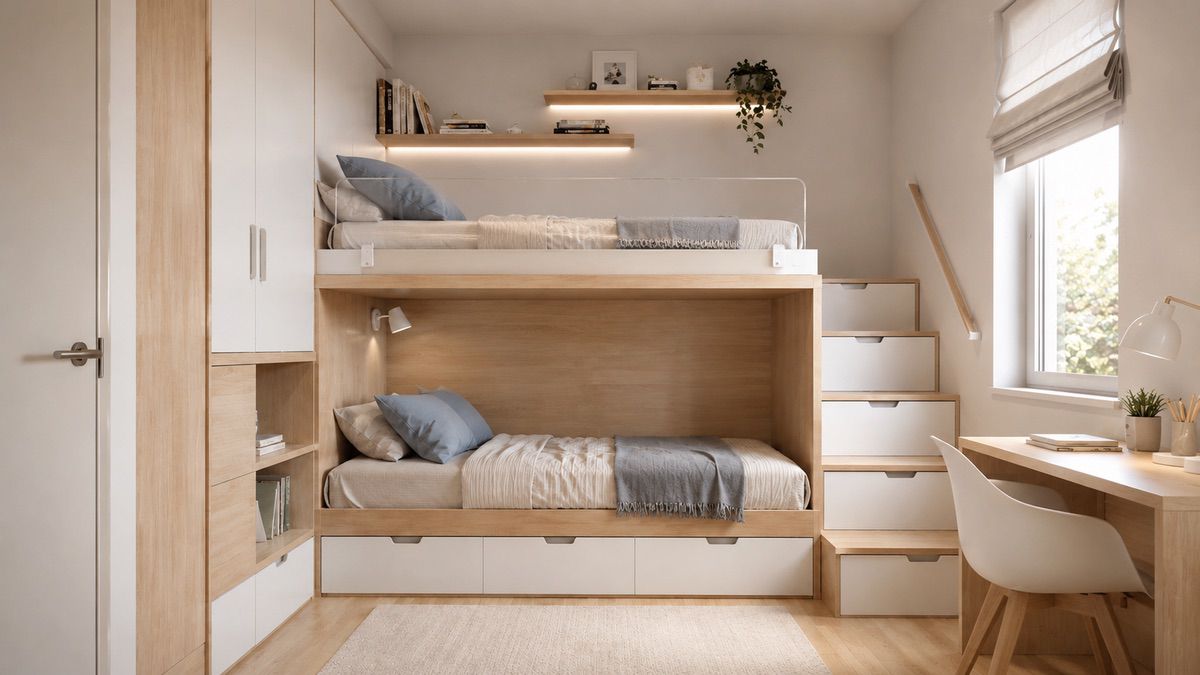
When a room is small, the most effective way to fit two beds is often to make use of vertical space. Bunk beds allow you to stack the two beds on top of each other and free up a significant amount of floor space.
This solution is particularly useful when the room also needs to accommodate a closet, a desk, and storage units. Instead of placing two beds on the floor, the sleeping area is concentrated within a single footprint, leaving more space for other functions.
Bedrooms with bunk beds are therefore an attractive option for shared bedrooms, especially if they are designed with guardrails, safe ladders, and built-in storage. The difference from a standard bunk bed lies precisely in the design: the ladder, drawers, bookshelves, and storage compartments can all become part of the same unit.
4. Pull-out bed: two beds when needed, more space during the day
Another very effective solution is a pull-out bed. In this case, the main bed is always available, while the second bed is pulled out only when needed. During the day, the bedroom stays more open and tidy.
This option is ideal when the second bed isn’t used every night, or when you want to keep a larger central area for play and study. It can also be useful in rooms where two fixed beds would make it impossible to comfortably open closets and drawers.
Bedrooms with pull-out beds allow you to transform a small room into a flexible space: at night, it provides two sleeping spots; during the day, it frees up floor space. This solution is particularly well-suited when you want an extra bed for guests, siblings, or friends.
5. Staggered or corner beds: when the room isn’t a regular shape
Not all children’s bedrooms have a simple layout. Sometimes a door interrupts a wall, a window limits the placement of the closet, or the room has awkward proportions. In these cases, two parallel beds or a traditional bunk bed might not be the best choice.
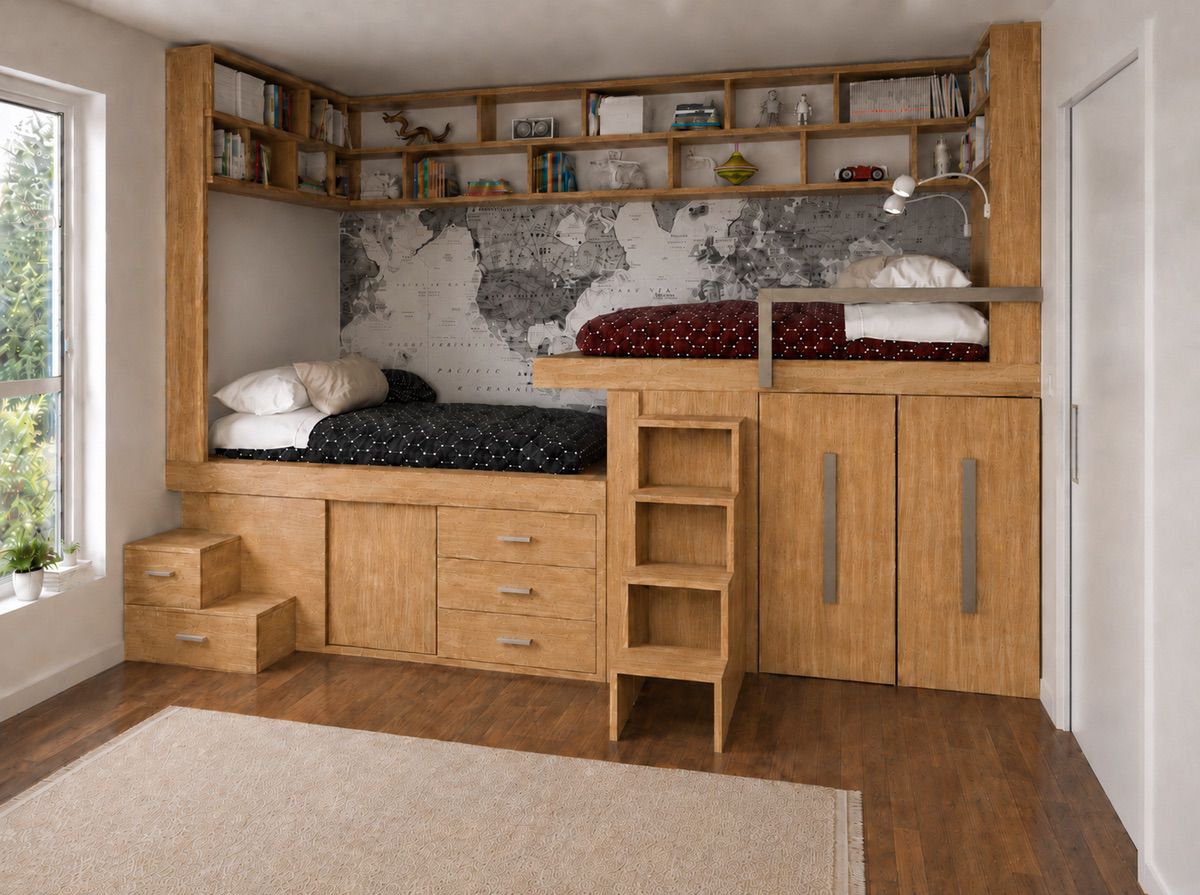
Offset or corner beds allow you to adapt the layout to the actual shape of the room. One bed can be higher, the other lower; one can run along one wall and the other in a different direction; some modules can include bookshelves, closets, or storage units.
SpazioBed’s 2- or 3-bed children’s bedrooms often follow this approach: not a one-size-fits-all solution, but different configurations based on the number of beds, the shape of the room, and storage needs.
6. Incorporate a closet and under-bed storage
In a small bedroom with two beds, the closet is often the real problem. Two children or teenagers need clothes, backpacks, books, toys, and personal items. If a traditional closet takes up an entire wall, the space for the beds is further reduced.
An effective solution is to raise one of the beds and use the space underneath as storage. This way, the bed’s volume is put to dual use: the top for sleeping, and the bottom for a closet, drawers, rolling cabinets, or small personal storage compartments.
Bedrooms with walk-in closets are particularly useful when the room needs to accommodate two people but doesn’t have enough space for a large, separate closet. The built-in storage reduces the number of freestanding pieces of furniture and makes the room look neater.
7. Two Beds in a Small Bedroom: What to Consider Before Making a Decision
Before deciding on the final layout, it’s a good idea to consider a few practical aspects. Will the room be used by two young children or older kids? Do you need a double desk, or is a shared study area enough? Will the second bed be used every day or only occasionally? Should the closet be in the bedroom, or can it be in another room?
The answers can significantly change the design. Two young children may need more play space; two teenagers will need more storage, desks, and privacy. In both cases, however, the principle remains the same: the room must be designed to accommodate the actual habits of those who live there.
If the bedroom is already furnished and feels too cluttered, it might be helpful to start with a guide on how to free up space in a bedroom. If, on the other hand, the issue mainly concerns the choice of materials and durability, you can also explore the topic of space-saving solid wood children’s bedroom sets from Fratelli.
Is a standard solution better, or a custom-designed bedroom?
When space is limited, a standard solution can leave many centimeters unused. The bed fits, but the closet blocks the way. The desk fits, but the chair doesn’t open properly. The second bed is there, but it makes it difficult to use the rest of the room.
A custom-designed children’s room, on the other hand, starts with the actual room itself: its width, depth, height, the location of the door and window, the number of children, and the necessary functions. Small children’s rooms require precisely this kind of attention, because every decision affects their day-to-day livability.
In conclusion, fitting two beds into a small bedroom is possible, but it requires a smart design. Parallel beds, beds arranged in a row, bunk beds, pull-out beds, staggered arrangements, and a walk-in closet under the bed each meet different needs. The best choice isn’t simply the one that fits two beds, but the one that keeps the room comfortable, tidy, and adaptable as the people living there grow.