
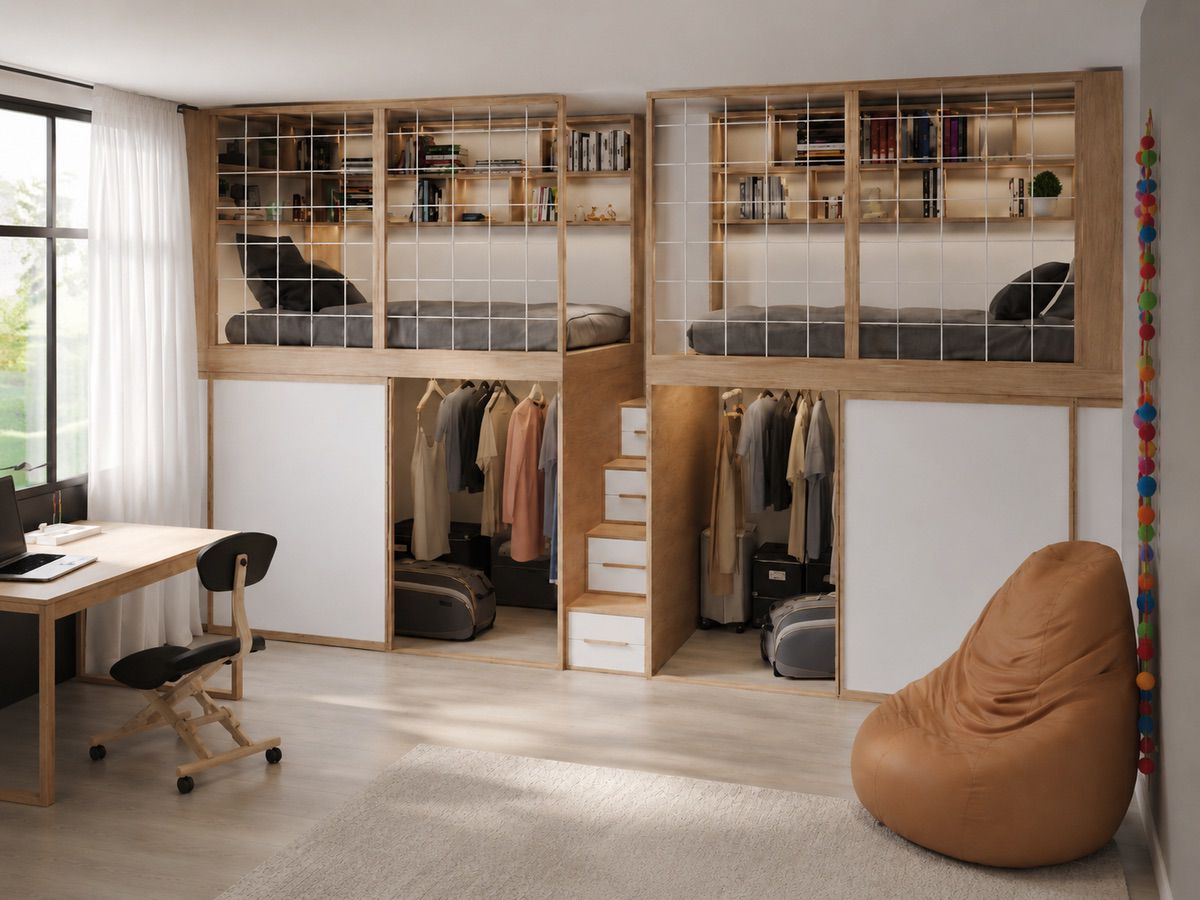
When looking for the dimensions of a twin-bed room, it’s easy to find conflicting information: 14 square meters, 16 square meters, minimum dimensions per bed, and recommendations for width and depth. This apparent confusion stems from an important point: not all standards refer to the same type of room. A bedroom in a standard home is one thing; a room intended for a lodging facility, a vacation home, or a tourist apartment is quite another. For this reason, before designing a small room with two beds, it is essential to distinguish between regulatory requirements, actual livable space, and the chosen furnishing solution.
When it comes to children’s and teenagers’ bedrooms, the issue becomes even more practical: simply fitting two beds inside isn’t enough. You also need to include a wardrobe, storage units, a desk, comfortable walkways, and, if possible, a little free space to move around. That’s why rooms with two or three beds must be designed with a different approach than a traditional bedroom.
Room with two beds: 14 square meters or 16 square meters?
For standard residential units, the most widely recognized national standard is the Ministerial Decree of July 5, 1975, which stipulates that a bedroom must have a minimum floor area of 9 square meters if intended for one person and 14 square meters if intended for two people. The same decree also sets requirements regarding interior ceiling height, typically 2.70 m, and the presence of a window that opens. The 16-square-meter figure, on the other hand, is often associated with vacation homes and apartments in certain regional contexts, where a minimum of 8 square meters per bed may be required. In that case, two beds would indeed require 16 square meters. However, it is important not to confuse this figure with the general rule applicable to all private residences.
In summary: for a standard two-person bedroom in a private home, the general guideline is 14 square meters; different requirements may apply to certain lodging or tourist facilities. In any case, it is always advisable to check the local building code, the property’s designated use, and consult a professional.
The legal minimum doesn’t always mean a comfortable bedroom
A 14-square-meter bedroom may be standard-sized, but it’s not necessarily easy to furnish with two beds. Much depends on the shape of the room. A nearly square room offers more layout possibilities; a long, narrow room, on the other hand, can make it more complicated to fit two beds, a wardrobe, and a study area. For this reason, when considering the dimensions of a room with two beds, you must also look at the proportions. A width of around 2.50–2.80 m can allow for some solutions, but requires careful planning. With two traditional floor-standing beds, the side space can be significantly reduced. With vertical, pull-out, or staggered solutions, however, the same floor space can be utilized more effectively.
If the main issue is the width, you may also find it helpful to read the article on the minimum width for a children’s bedroom, because a room with two beds isn’t just about square footage—it’s also about walkways and actual space requirements.
Two beds on the floor: when do they actually work?
Two traditional single beds can work well if the bedroom is large enough and has a regular layout. The simplest arrangement is to place the beds side by side, separated by a central aisle or a small nightstand. Alternatively, in a long room, the beds can be placed in a row along the same wall.
The problem is that this solution takes up a lot of floor space. Two beds on the floor, even if they’re single beds, reduce the space available for closets, desks, and play areas. For a child’s or teenager’s bedroom, this can be a major limitation, especially if the room also needs to be used for studying or storing many items. In a small bedroom, therefore, two traditional beds are often the easiest option to imagine, but not always the most efficient. When space is limited, it’s worth considering alternatives that free up floor space.
Bunk beds, staggered beds, or pull-out beds: how the required dimensions change
The choice of bed type radically changes the way the room is used. Bunk beds stack the two sleeping areas on top of each other, freeing up floor space. Offset or corner beds, on the other hand, allow for a more dynamic layout, which is useful when the room doesn’t allow for a symmetrical arrangement. Finally, a pull-out bed is a good option when the second bed doesn’t need to stay open all the time.
Children’s bedrooms with bunk beds are ideal when the ceiling height allows for them and when you want to keep the sleeping area within a single footprint. Solutions with a pull-out second bed, on the other hand, are useful when you want to keep the room more open during the day. The SpazioBed catalog features configurations designed specifically for these needs: structures with a high bed and a pull-out second bed, corner beds, staggered layouts, sets for two siblings, and modules with built-in storage. In some solutions, single beds start at compact widths such as 86/96 cm, while other compositions require wider walls because they also incorporate wardrobes, trolleys, desks, or bookshelves.
How much space is needed in addition to the two beds?
A room with two beds shouldn’t just be for sleeping. It should also provide enough space to open drawers and closets, use a desk, safely climb into a loft bed (if there is one), make the bed, and move around without obstruction.
That’s why the design must take into account the furniture’s actual footprint, not just its closed dimensions. A cube-style ladder can take up space, but it can also house drawers. A pull-out cart requires space to open, but it can replace a traditional wardrobe. A loft bed requires attention to the room’s height, but it can free up space underneath the structure. This is where space-saving kids’ rooms become most interesting: they don’t just reduce the size of the furniture, but combine multiple functions within the same space. If you’d like to start with a more general approach, you can also read the guide on how to create a space-saving bedroom.
A Room for Two Brothers: Privacy and Organization Are Just as Important as Square Footage
When two children or teenagers share a room, minimum size requirements are only part of the problem. You also need to consider privacy, organization, and the separation of personal spaces. Each child should have their own place to sleep, a space for clothes and personal items, a study area, or at least a work surface. Even in a small room, this separation can be achieved with smart solutions: staggered beds, built-in bookcases, dedicated drawers, small personal compartments, or structures that visually divide the functions.
That’s why children’s bedrooms shouldn’t be designed merely as rooms with two beds, but as complete living spaces. This is even more evident when it comes to space-saving solid wood bedrooms for siblings, where sturdiness, durability, and space organization take center stage.
What if you need three beds?
When the number of beds increases to three, the approach changes again. It’s not enough to simply add an extra bed; you have to completely rethink the room. In many cases, this involves using a high bed, a low bed, and a pull-out third bed, or solutions that combine bunk beds, pull-out modules, and storage units.
Three-bed children’s rooms are useful when the room needs to accommodate multiple children, siblings of different ages, or an extra bed for guests. Even in this case, floor space alone isn’t enough: what matters is how the beds are arranged and how the furniture combines storage with clear pathways.
Two beds in a long, narrow room
A long, narrow bedroom may seem difficult to furnish, but with two beds, it can also offer some opportunities. The beds can be arranged in a row, one after the other, or placed on different levels to free up part of the room. The risk is creating a corridor-like effect, with furniture on both sides and passageways that are too narrow. To avoid this, it’s best to concentrate the main functions along one wall and leave the other more open. This approach is similar to the one used in the “track layout,” which is discussed in more detail in the article on long, narrow bedrooms.
Here, too, custom design can make all the difference: a standard unit may leave unused space, while a layout designed to fit the actual dimensions can make more precise use of the walls, ceiling height, and depth.
Dimensions of a twin bedroom: should you start with the square footage or the floor plan?
Square footage is essential for determining whether a room is suitable. However, when it comes to a two-bedroom apartment, the layout is just as important as the square footage. A 14-square-meter room that’s poorly furnished can feel cramped and uncomfortable; a room designed with loft beds, built-in storage, and pull-out solutions can be much more functional. If the bedroom already exists and feels too cluttered, it may be helpful to start with a practical assessment of how to reclaim space. If, on the other hand, the room needs to be designed from scratch, it’s best to consider right away the number of beds, storage, study space, and how the children will grow over time.
In conclusion, a room with two beds must meet the minimum requirements for its intended use, but above all, it must be practical for everyday life. For a typical home, 14 square meters is the general standard for two people; in other settings, such as some vacation homes, different standards may apply. But the real question remains: do those square meters truly allow two children or teenagers to live comfortably in the room? SpazioBed solutions were created precisely to address this need: to transform a room with two beds into an organized, compact, and livable space, where every inch is used not just to fit the furniture, but to enhance the quality of the space.