

There are far more alternatives to a bedroom closet than you might think: dressers, chest of drawers, small dressers, open coat racks, built-in niches, walk-in closets, storage beds, and systems that store your wardrobe directly under the bed. To make the right choice, however, it helps to shift your perspective. A closet isn’t just a large piece of furniture—it serves several functions at once. It allows you to hang clothes and jackets, store folded garments, keep linens and out-of-season clothing, organize shoes and accessories, and hide everything from view.
The real question, then, isn’t just “What can I put in place of the closet?” but which of these functions are actually needed in the room and where they can be moved. In a small bedroom, for example, getting rid of a traditional closet and replacing it with four different pieces of furniture could actually make the problem worse. A good alternative, on the other hand, should free up space, maintain convenient access to clothes, and, if possible, reduce the overall number of furniture pieces.
Before replacing the wardrobe, separate the wardrobe functions
The most effective method is to divide what we normally store in our closets into four broad categories: hanging items, folded items, seasonal items, and small accessories . Shirts, jackets, coats, long dresses, and some pants require hanger space. Sweaters, sweatshirts, underwear, and linens, on the other hand, can be stored very well in drawers. Duvets, blankets, and seasonal items don’t need to be reached every day and can therefore occupy deeper or less accessible compartments. Shoes, belts, bags, and small accessories require dedicated shelves or containers.
This line of reasoning helps you determine whether you really need a traditional closet. Someone who has few items to hang and many folded clothes could organize everything perfectly with a dresser and a small hanging rod. A couple with a lot of clothes, on the other hand, will need a dedicated wardrobe area, though it doesn’t necessarily have to be inside a classic built-in closet. The layout also depends on the shape of the room. Before choosing a solution, it’s best to assess doorways, doors, and windows, as also explained in the guide on how to arrange furniture in a small bedroom. The goal , therefore , is to replace the functions of the closet, not simply the piece of furniture itself. It is this distinction that allows you to design a bedroom that truly feels more spacious.
Dressers, chests of drawers and low containers: when clothes can be folded
The simplest solution to reducing or eliminating closet space is to use dressers, chests of drawers, and tallboys . They’re particularly suitable for knitwear, underwear, pajamas, sportswear, linens, and other foldable items. The advantage is that they don’t necessarily require a full-height wall. The top surface can also be used as a shelf, while a tallboy provides mostly vertical storage, taking up a relatively small portion of the wall. The drawback is equally obvious: a chest of drawers doesn’t replace the space needed to hang jackets, shirts, and dresses. For this reason, it works very well as a partial alternative, especially when combined with another hanging solution.
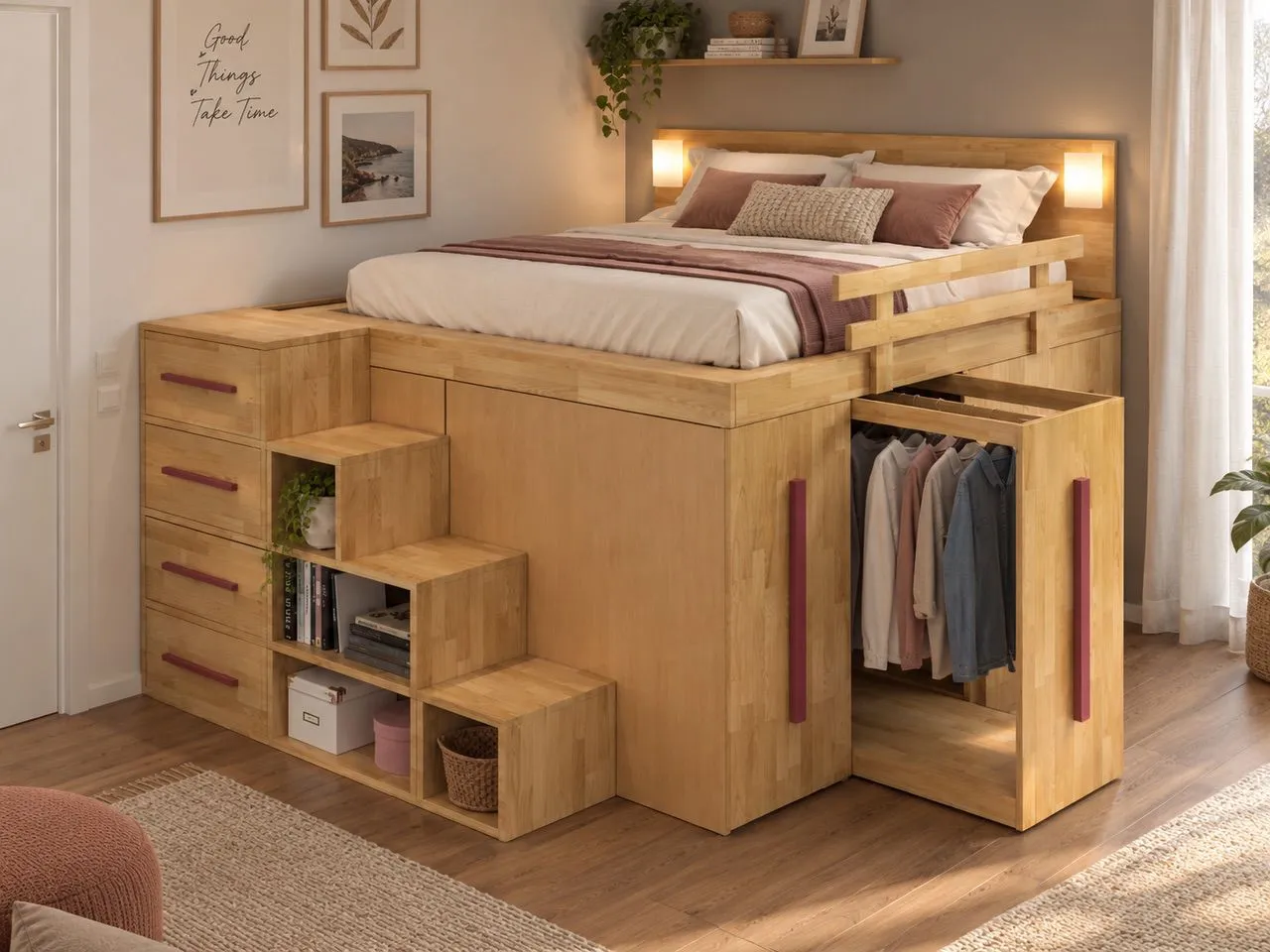
An interesting development involves integrating drawers directly into the bed. SpazioBed bedrooms with drawers use the space beneath the sleeping area to create actual drawer units, eliminating the need to add another piece of furniture against a wall. One example is the Torino 1 loft bed with drawers: storage is concentrated directly beneath the sleeping surface. The design differs from the classic storage bed: instead of opening a large storage compartment, it features independent drawers accessible from the front. For those who want to better understand the difference between these configurations, it may also be helpful to read the in-depth article on what a storage bed is and how it works. The drawer unit thus becomes a very effective alternative when a large portion of your wardrobe consists of folded items. If, on the other hand, hanging garments make up the majority of your wardrobe, you’ll need to add a second storage function.
Open hangers, niches, and closets: alternatives for hanging garments
If the closet is primarily used for hanging clothes, one of the most immediate options is a clothes rail . It can be fixed to the wall, installed in a recess, or used in an open structure. Clothes rails and open wardrobes offer immediate access and can visually lighten the space, especially when they have thin structures. However, they are suitable for those who manage to keep their wardrobe tidy: leaving many items on display can quickly have the opposite effect and make the room appear more crowded. Dust must also be considered. A completely open system exposes clothes and accessories more to the environment. If this aspect is important, a solution screened by curtains, panels, or sliding doors may be preferable.
For example, an existing niche can be turned into a closet area by adding coat racks, shelves, and drawers. If there is enough space, this same approach can be expanded into a full-fledged custom walk-in closet. The walk-in closet doesn’t necessarily have to be a large, separate room. It can occupy a portion of the bedroom, a niche, or a wall fitted with hanging rods, shelves, and drawers. In our article on the benefits of walk-in closets, we explored the differences compared to a traditional closet. A closed system with sliding doors also allows you to hide the closet from view without requiring the front space needed to open large hinged doors. In a small room, however, even a traditional walk-in closet takes up space. This is where it becomes interesting to completely shift the problem: instead of looking for another wall for the closet, you can use the space under the bed.
SpazioBed: Move the closet, drawers, and coat rack under the bed
One of the most radical alternatives to the traditional closet is not to replace it with another wall-mounted piece of furniture, but to move its functions under the sleeping area. This is the principle behind many SpazioBed master bedrooms. The bed is raised to a height determined during the design phase, and the space underneath is configured according to what it needs to hold. If you mainly need to store folded clothing, dressers and large drawers can be placed under the bed.
If you need to hang clothes, a particularly interesting solution is a rolling wardrobe. In rooms with rolling wardrobes, the pull-out modules can be equipped with coat hangers or shelves and are accessed from the front. A concrete example is the Lucca double bedroom with hanging wardrobe carts. Instead of having a large built-in closet against the wall, the storage capacity is distributed among units that slide under the bed.
If, on the other hand, you need a true closet area, the lower section can be closed off with doors and organized with hanging rods and shelves. Bedrooms with a closet below follow this very principle: the closet doesn’t lose its function, but it no longer takes up another wall in the room. The Milano master bedroom with a built-in closet below is a good example of this layout. The space occupied by the bed is also utilized vertically for storage.
It’s important to distinguish this solution from a simple, traditional storage bed. The classic storage compartment is useful for comforters, suitcases, and seasonal clothing; a closet, dresser, or rolling cart under the bed, on the other hand, can be designed for everyday use. Those who prefer the traditional system can still explore storage beds as well. The same approach can be applied to children’s bedrooms. Children’s bedrooms with walk-in closets use the space under the sleeping area to create storage without taking up another wall with a large closet. The design advantage is particularly evident when the room has few available walls, when a window interrupts the main wall, or when a traditional closet would make the passageways too narrow.
What’s the
best
alternative to a closet? It depends on the room and your wardrobe
There’s no single “best” solution. The choice depends mainly on how much you need to store and how you use your clothes. If most of your clothes are folded, a large dresser or several built-in drawers may be enough. If you wear a lot of shirts, dresses, and jackets, however, you’ll need hanging space: an exposed rod, a fitted niche, a walk-in closet, or wardrobe carts. If the bedroom has an unused niche, using it as a closet may be more practical than adding a standard piece of furniture. If, on the other hand, there is no free wall space at all, moving the storage under the bed may be a more effective solution.
In studio apartments, this consideration becomes even more important: the bed, closet, and living area must all coexist in the same space, and every separate piece of furniture takes away space from other functions. Aesthetics matter, too. An open coat rack can look very airy but requires constant organization. A dresser hides everything but doesn’t allow you to hang items. A walk-in closet concentrates your wardrobe in a dedicated area. A loft bed with a built-in closet or storage units, on the other hand, completely changes the layout of the room. For this reason, before buying new furniture, it’s best to start with the floor plan. This guide on how to furnish a small bedroom helps you evaluate the bed, storage, and walkways together.
The most important rule is to avoid replacing a large closet with many small pieces of furniture without a plan. Five separate pieces can take up more space and create more clutter than a single, well-organized closet. The best alternatives to a bedroom closet are therefore those that redistribute its functions: drawers for folded clothes, hangers for hanging items, dedicated compartments for seasonal clothing, and closed storage systems for items that shouldn’t be left out in the open.
When space is truly limited, the next step is to make use of the third dimension as well. Instead of just wondering which piece of furniture could replace the closet, it’s worth asking where the wardrobe can be moved. Placing it under the bed is one option that allows you to make a more significant change to the room’s layout.