
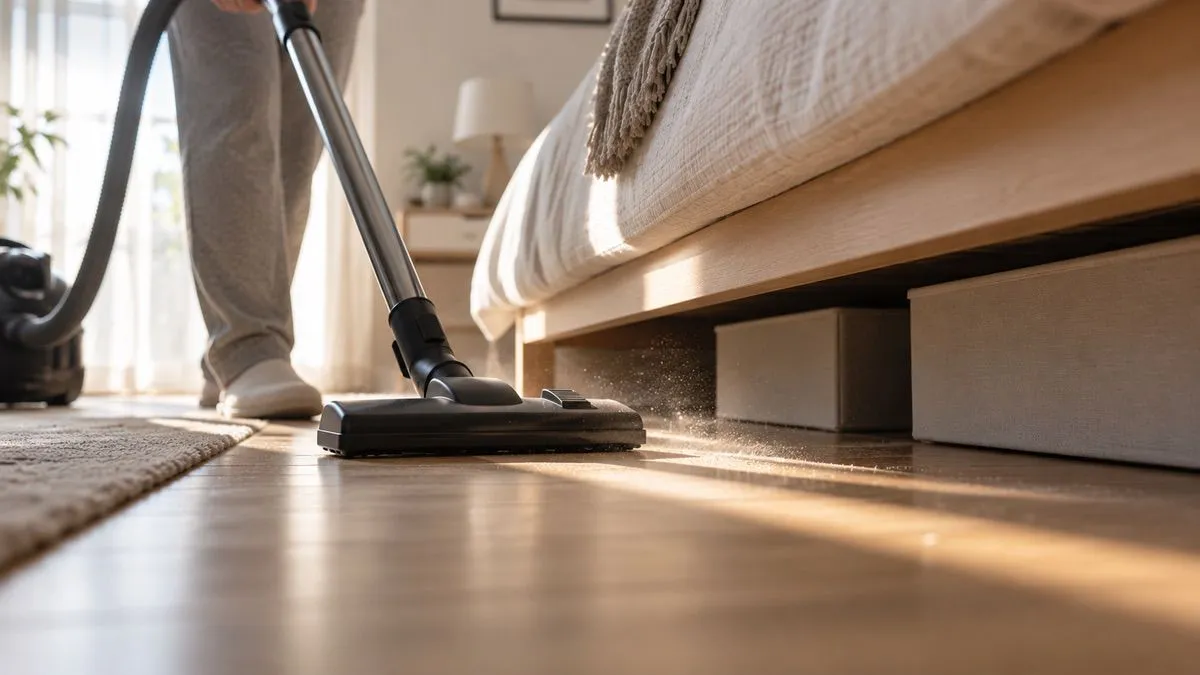
Dust in a storage bed is a fairly common problem, especially in traditional models with a large storage compartment under the bed frame. Even when the compartment appears to be closed, small gaps along the perimeter, seams in the bottom, openings near the lifting mechanism, and space between the bed frame and the structure can allow dust to slowly seep in. The most effective solution, therefore, is not to constantly clean the storage space, but to reduce the number of entry points at the source. Proper seals, storing items in closed containers, proper floor cleaning, and a frame designed with tight-fitting closures can make a big difference.
First, however, it’s important to distinguish between the classic storage bed with a storage compartment and the SpazioBed raised-floor solutions: not all systems store items in the same way, and, as a result, not all are exposed to dust in the same way. For a technical explanation of the different types, start with the guide on what a storage bed is and how it works; for a more comprehensive assessment of the limitations of the traditional system, take a closer look at the disadvantages of storage beds.
Where does dust enter the container bed?
House dust doesn’t just come from outside. It also consists of textile fibers, hair, skin particles, pollen, soil, and other materials present in the environment. As the U.S. Environmental Protection Agency explains, dust deposited on the floor can easily be recirculated simply by walking or carrying out normal household activities.
The bed is very close to the floor and takes up a significant amount of space. If the storage compartment has small openings, some of the dust circulating in the room can end up inside it. In a classic storage bed , the areas to check are primarily the edge where the slats meet the frame, the corners, the joints of the bottom panels, and the areas near the opening mechanism. It doesn’t necessarily take a large gap: even a tiny opening, repeated along several meters of the perimeter, can be enough for dirt to accumulate over time.
Check and reduce container gaps
The first step is to check, with the container empty, where dust can enter. It’s helpful to lift the mesh, remove any objects, and carefully inspect the entire interior perimeter. If the model allows it, thin rubber or foam adhesive seals can be used on the contact areas to reduce gaps. However, they must be applied without interfering with hinges, pistons, lifting systems, or ventilation points provided by the manufacturer.
The bottom should also be inspected. If it consists of multiple panels, make sure they are properly positioned and that there are no obvious gaps leading to the floor. Before modifying or permanently sealing the structure, however, it’s always best to check the manufacturer’s instructions: indiscriminately closing every gap isn’t necessarily a good solution.
Don’t confuse dust protection with mattress ventilation
This is an important technical point. To prevent dust from entering, you might be tempted to completely seal off the area immediately beneath the mattress with plastic panels or waterproof surfaces. This isn’t always advisable.
The bed base, slats, and mattress support also serve a ventilation function. Protection of the storage compartment should therefore focus primarily on the perimeter and the elements actually intended to close off the compartment, without turning the surface under the mattress into a makeshift barrier. The same principle applies to certain SpazioBed models equipped with slats and Tatami. The bed surface is designed to be breathable and should not be considered the system’s dust barrier. Protection of the contents is achieved primarily through proper design of the side and front closures.
Protecting Items Stored in the Storage Compartment
Even a good storage bed doesn’t necessarily have to be treated as a completely sterile environment. For items that remain in the storage compartment for months, it’s always a good idea to provide an extra layer of protection. Duvets, blankets, out-of-season clothing, and other textiles can be stored in boxes with lids, sealed storage bags, or vacuum-sealed bags, provided they are compatible with the stored items. This way, even a small amount of dust that might enter the storage compartment won’t come into direct contact with the fabrics.
The boxes also have another advantage: they prevent the storage bed from turning into one big space where everything gets piled up. To learn more about the technical principles behind the various storage systems, the article on the history of the storage bed is also helpful.
Clean the floor first, not just the container
If a lot of dust accumulates around the bed, the amount of dust that can reach the compartment will inevitably increase as well. Prevention must therefore start in the room itself. It’s helpful to vacuum around the perimeter of the bed regularly, especially in the corners and hard-to-reach areas. A vacuum cleaner equipped with a HEPA filter can help prevent some of the particles you’ve vacuumed up from being released back into the air.
When it comes to surfaces, it’s best to avoid simply sweeping dust away with dry tools. Even the CDC recommends microfiber as a particularly effective material for trapping dirt and particles. A slightly damp microfiber cloth is therefore useful for the inside edge of the container, the panels, and accessible surfaces. If the room is very small, arranging the furniture in a more organized way also makes cleaning easier. In the article on how to arrange furniture in a small room, we saw how important it is to keep the main pathways and service areas accessible.

The SpazioBed Solution: Tackling Dust Through Design
The SpazioBed concept differs from the traditional storage bed, where the bed base and mattress are lifted to access the storage space. In double bedrooms, the bed can be raised, and the space underneath can be organized with drawers, roll-out units, or actual closet compartments. This is also important for dust control, because not all configurations are closed off in the same way. A drawer system, for example, has different characteristics than a cart that’s open at the top; a closet with sliding doors, on the other hand, can be designed to offer greater protection.
That’s why SpazioBed doesn’t offer a single solution for the concept of a storage bed. Bedrooms with drawers, bedrooms with roll-out units, and solutions with wardrobes all have different access systems and should be chosen based on what you want to store.
Japanese-style doors and milled tracks: when dust is contained at the source
The most interesting SpazioBed configurations from this perspective are those in which the space under the bed is enclosed with Japanese-style Shoji or Fusuma sliding doors. The system uses guides milled using a Japanese technique and does not require the traditional complex sliding mechanisms. Cinius describes these configurations as designed to achieve a dust-proof and wear-resistant closure. Those interested in the technical details of the system can consult the SpazioBed solution with sliding doors.
Closets with built-in cabinets can therefore address the issue differently than traditional cabinets: instead of trying to seal a compartment with small gaps after it has been built, the sealing is factored into the design from the start. This is the same logic used in Cinius walk-in closets. In our in-depth article on dust in walk-in closets, we analyzed in detail how Japanese-style doors and the guides used to limit dust entry work.
Please note: Not all SpazioBed solutions are enclosed in the same way
It’s important to be precise. Saying that a specific configuration with Japanese-style doors is designed to keep dust out does not mean that any space under any SpazioBed is automatically sealed off. A pull-out drawer, a chest of drawers, an open compartment, and a closed cabinet all have different characteristics. Even the presence of tatami mats or slats on the bed surface does not, by itself, provide dust protection.
The right solution should therefore be chosen during the design phase based on the intended use. If clothes and linens are to be stored under the bed on a daily basis, protection from dust can be an important factor in choosing the storage closures. If, on the other hand, the space is intended for suitcases or bulky items, simpler systems may suffice. This assessment should be incorporated into the overall design of the room. Anyone looking to furnish a small bedroom should therefore decide not only how much storage is needed, but also what types of items will be stored under the bed.
If you already have a storage bed: a practical procedure
If a storage bed is already installed, the best approach is to proceed step by step. First, completely empty the space and clean the bottom, edges, and surrounding floor. Then, inspect any areas with obvious cracks. You can then consider removable seals in areas compatible with the structure, properly install any bottom panels, and organize items inside closed containers. Finally, it’s helpful to keep the floor around the bed clean, because the less dust there is in the room, the less dust will reach the container .
In studio apartments and very compact rooms, where the bed and living area often share the same space, this maintenance can become even more important because the bed is located near many of the usual daily activities.
Container bed dust: prevention is more effective than constant cleaning
In conclusion, to prevent dust in a storage bed, you need to work on three levels: reduce gaps, protect your items, and reduce the amount of dust around the bed . In a traditional storage bed, seals compatible with the mechanism, closed boxes and cases, checking the bottom, and periodically cleaning with a vacuum cleaner and microfiber cloth can be helpful. However, it’s inadvisable to improvise seals that could interfere with the bed’s operation or proper ventilation of the mattress area.
With SpazioBed solutions, this issue can be addressed as early as the design phase. When you choose a configuration with Japanese-style sliding doors and a closed closet compartment, the doors are specifically designed to minimize dust entry. This isn’t a feature of every possible configuration, but it’s a practical option for those who prioritize protecting the contents.