
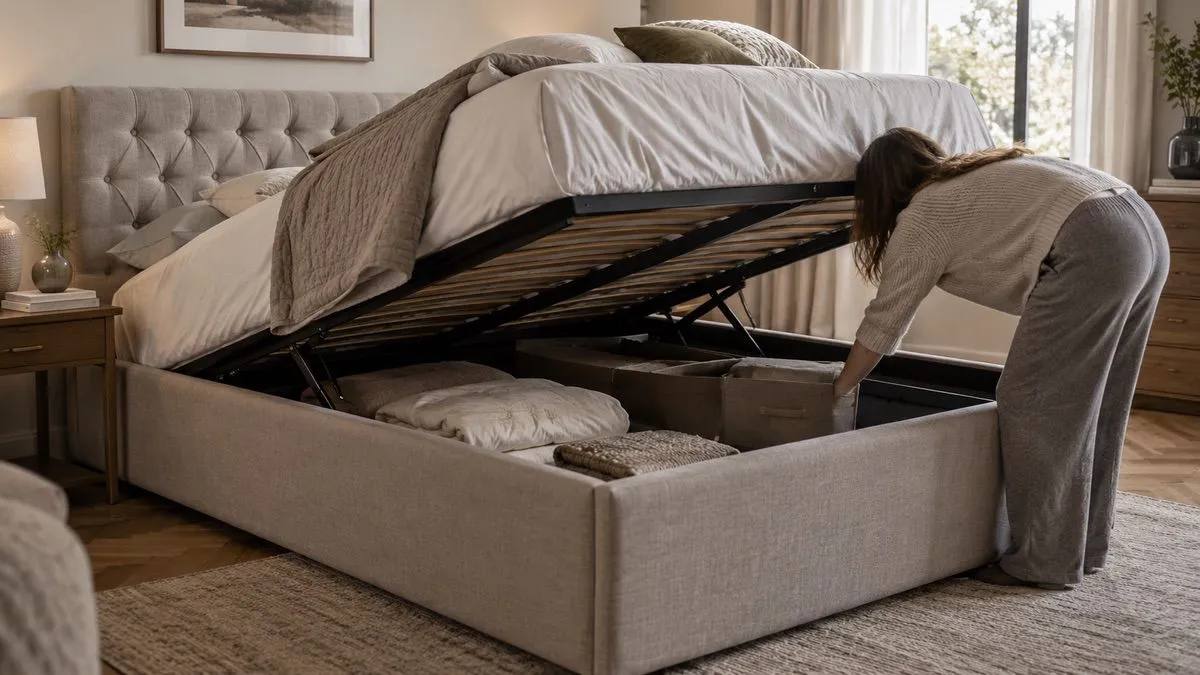
The disadvantages of a storage bed stem primarily from the way the storage compartment is designed. In the traditional model, in fact, there is a large storage compartment beneath the bed frame and mattress, which is accessed by lifting the bed surface using a mechanical system. This is an effective solution when you need ample storage space for comforters, blankets, suitcases, and items used only occasionally. However, the very presence of the storage compartment and the opening mechanism introduces certain limitations: less immediate access, more labor-intensive cleaning, a heavier structure, and a large compartment that isn’t always easy to organize.
This doesn’t mean that a storage bed is the wrong choice. Cinius also offers traditional storage beds for those who prefer this type of design. However, there are also different ways to use the space under the bed: many SpazioBed solutions are based precisely on this idea. To learn more about the definitions and how the various systems work, you can also read our guide to storage beds.
1. To access the storage compartment, you must lift the bed base and mattress
This first limitation is also the technical defining feature of the classic storage bed. To retrieve items stored inside, you must lift the bed base along with the mattress, typically using gas struts or other assisted-lifting systems. For items used only a few times a year, this isn’t a major issue. Summer comforters, winter blankets, suitcases, and seasonal clothing are well-suited for this type of storage space. However, if you want to use the storage space every day, opening it may be less convenient than opening a regular drawer or a closet.
It’s also important to keep in mind that there may be pillows, blankets, or other items on top of the bed that need to be put away before opening it. While the large storage space is practical, it isn’t always the most convenient storage solution for everyday use.
2. Cleaning can be more complicated
Another of the most well-known drawbacks has to do with cleaning. Many storage beds are built very close to the floor: the space underneath may be too low to easily get a vacuum cleaner, broom, or robot vacuum through. The interior compartment must also be emptied periodically in order to clean it thoroughly. If it’s full of boxes, comforters, and suitcases, the task inevitably takes longer than cleaning an open space.
The problem isn’t limited to the bed. Household dust that has settled on the floor can be stirred up simply by walking or during normal household activities. Reducing hard-to-reach areas therefore also helps with general bedroom maintenance. When arranging furniture in a small bedroom, it’s worth considering from the start not only where the furniture will fit, but also how it can be cleaned and used.
3. Dust can also enter the compartment
The box seems completely sealed, but it isn’t always. Seams in the bottom, edges of the frame, and areas necessary for the mattress to move can leave small openings through which dust slowly enters the container. For this reason, comforters, clothes, and textiles stored for months are often placed in closed boxes, cases, or bags. However, protection from dust is a specific issue and depends heavily on the bed’s construction: not all containers are sealed in the same way.
To explore this issue in more detail, we’ve prepared a guide on how to keep dust out of storage beds. The same problem also arises in walk-in closets and open wardrobes. In our article on dust in walk-in closets, we took a closer look at the role of closures and sliding doors in minimizing the problem.
4. Structure and Mechanism Make the Bed More Complex
A traditional bed can be structurally very simple: a frame, a slatted base, and a mattress. A storage bed adds a storage compartment, movable components, and a lifting system. This means more parts that must work together properly. Pistons, hinges, and mechanisms must be suited to the slatted base and the weight of the mattress. Over the years, they may require adjustments or replacement, especially with frequent use or if the components are not properly sized.
It is no coincidence that UNI EN 1725:2024 addresses the safety, strength, and durability of beds and their components, with additional requirements applying when the furniture incorporates extra functions such as storage. This does not mean that a good mechanism is fragile, but simply that a moving component adds complexity compared to a fixed structure.
5. A storage bed is generally heavier to move
The storage compartment requires side panels, a bottom panel, a slatted base, and hardware. The result is usually a heavier structure than a basic bed with a frame and legs. The difference is especially noticeable when you need to move the bed to clean, rearrange the room, access the wall behind it, or move to a new home. In a spacious, permanent bedroom, this aspect may be of little consequence. It becomes more important, however, in small apartments or spaces that are rearranged over time, where the flexibility of the furniture can be a greater asset.
6. A single large compartment doesn’t always mean better organization
The large volume of the storage compartment is one of the main advantages of a storage bed, but it can also become one of its limitations. Without boxes, dividers, or organizers, the space tends to turn into a large horizontal storage area. Items closest to the opening are easy to reach; those stored at the back may require moving whatever is in front of them. For this reason, the classic storage bed works particularly well for bulky items used only occasionally. If, on the other hand, you want to store everyday clothing, linens, accessories, or items that need to be accessed frequently, dividing the space into separate compartments may be more practical.
7. A storage base can make the bed appear more substantial
The traditional storage base fills the entire space between the bed frame and the floor. From an aesthetic standpoint, it creates a solid base that is more visually striking than a bed raised on legs. In spacious bedrooms, this can be perfectly in line with the chosen style. In a very small room, however, a large central block can contribute to the feeling that space is being taken up. When furnishing a small room, it’s often more helpful to consider the entire volume of the room—including the height—rather than focusing solely on the available floor space.
How SpazioBed Transforms the Concept of the Storage Bed
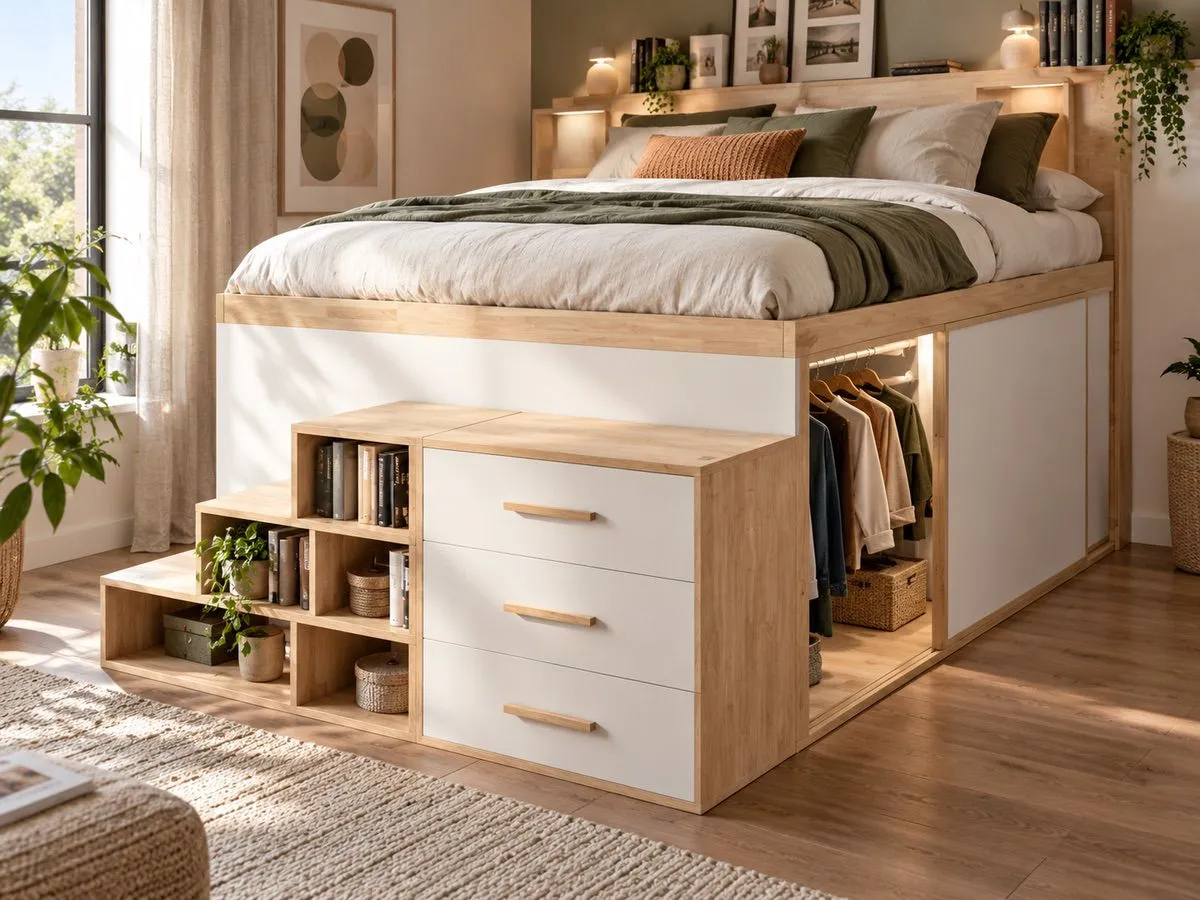
SpazioBed solutions are based on the same idea as the storage bed: the space occupied by the bed shouldn’t be wasted. However, the way this space is organized is different. Instead of necessarily creating a low storage compartment accessible by lifting the mattress, the bed is raised. Underneath the sleeping surface, you can then fit actual pieces of furniture: dressers, carts, wardrobes, shelves, or combinations of multiple modules.
In space-saving double bedrooms, the bed frame remains in place while the storage compartments are being used. This eliminates one of the main drawbacks of traditional storage beds right from the start: there’s no need to lift the bed frame and mattress every time you want to get something out.
Under-bed drawers: direct access and separate compartments
Bedrooms with drawers replace the large single compartment with independent drawers. Each drawer can be designated for a specific category: linens, knitwear, accessories, clothing, or other items. Access is from the front and immediate. The bed does not need to be opened, and the contents of the other drawers do not need to be moved. This makes the space under the sleeping area more like a real dresser than a storage area. This is an important difference, especially for those who want to use the storage space daily and not just when changing seasons.
Drawers: The drawer can be pulled out completely from the bed
Another option is the “chambers with drawers.” The modules are pulled out from the frame and can be configured as hanging rods or shelves. The advantage over a storage bin is the ability to access the contents from the front and see more clearly what is stored inside. Furthermore, when the configuration allows it, pulling out the module makes it easier to inspect and clean the space behind it.
Of course, the dressers require a clear space to pull them out: this solution, too, must therefore be designed based on the room’s actual dimensions. But it completely changes the relationship between the bed and the storage units.
Under-bed closet: the space becomes a real wardrobe
The next step is to transform the space underneath into a real closet. In rooms with an under-bed closet, the area beneath the bed can accommodate hanging rods, shelves, doors, and other elements typical of a wardrobe. The space is thus utilized vertically, without having to lift the bed. In some SpazioBed configurations, Fusuma or Shoji sliding doors—inspired by Japanese tradition—are also used.
These doors can slide along grooved solid wood tracks without using the traditional metal roller system. In specially designed configurations, a precise closing mechanism also helps limit dust ingress. This does not mean that all SpazioBed solutions have the same dust-proof features: drawers, trolleys, open compartments, and closed cabinets are all different systems. This is precisely why the design is chosen based on what needs to be stored.
Is the classic storage bed still a good option?
Yes. The drawbacks of the storage bed don’t mean this type should be avoided. A traditional storage bed can be very effective when the goal is to have a large storage space for bulky items used only occasionally. Those who prefer this solution may also want to consider Cinius storage beds, which represent the classic interpretation of the concept.
The choice changes when the space under the bed needs to become an important part of your daily storage solution. In that case, drawers, rolling carts, or an under-bed cabinet can offer more immediate access and better organization of the space. This is especially true in a space-saving master bedroom or in studio apartments, where every piece of furniture must serve multiple functions without complicating daily use.
Disadvantages of container beds: the problem is not containing, but how it is contained
In short, the main disadvantages of a traditional storage bed are related to its very structure: the base and mattress must be lifted, cleaning can be more laborious, dust can get into the compartment, the bed is generally heavier, and the opening system adds mechanical components. Furthermore, a single large storage compartment offers plenty of storage space but isn’t always the best way to organize your everyday essentials.
SpazioBed solutions don’t do away with the concept of a storage bed— they reinterpret it. The space under the bed remains a valuable resource, but it can become a dresser, a closet, or a system of independently accessible drawers—without having to move the mattress. The best choice therefore depends on how you plan to use the space. To store a few comforters during the summer, a traditional storage compartment may be perfect. To transform the space under the bed into a full-fledged part of your everyday furniture, however, it’s worth considering a raised, modular solution.
Anyone interested in learning more about the origins of this need can also read the history of the storage bed, which shows how the idea of making use of the space under the sleeping area has evolved over time into modern space-saving solutions.