
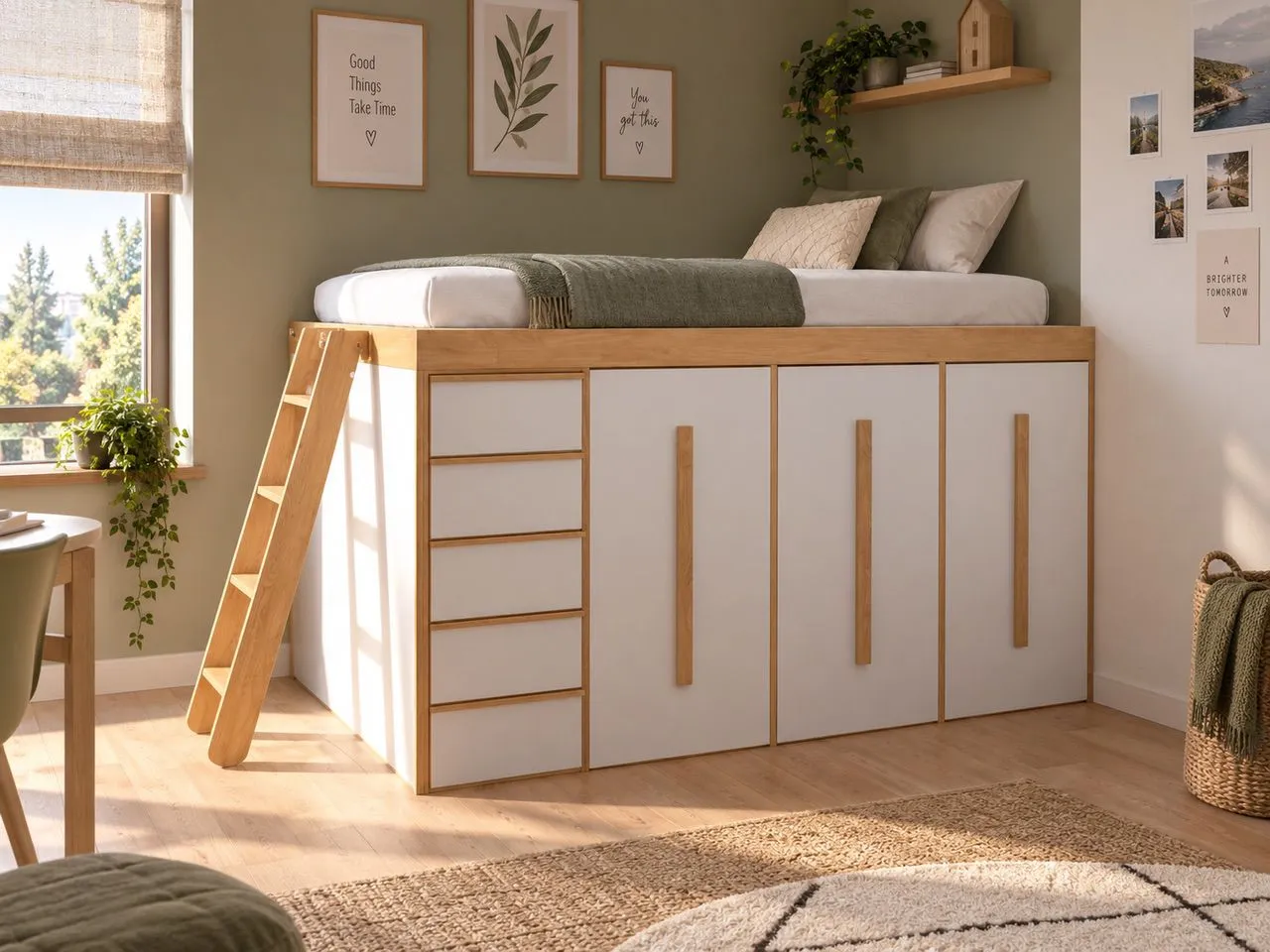
To make the most of the space under the bed, you need to start with a simple observation: not all beds are the same. Ten or twenty centimeters of free space allows you to fit shallow boxes; a storage bed offers a large horizontal compartment; by increasing the height of the frame, however, you can fit dressers, carts, wardrobes, and actual pieces of furniture under the bed. The best way to use the space under the bed therefore depends on three factors: how much volume is available, how often you need to access the items, and what function you want to achieve. A down comforter that’s taken out twice a year can be stored in a vacuum-sealed bag. Clothes worn every morning, on the other hand, require a much more accessible storage system. It is this distinction that should guide the design of the space under the bed: not as an empty space to be filled, but as a genuine part of the room’s volume to be organized.
Before deciding what to put under the bed, measure the available space
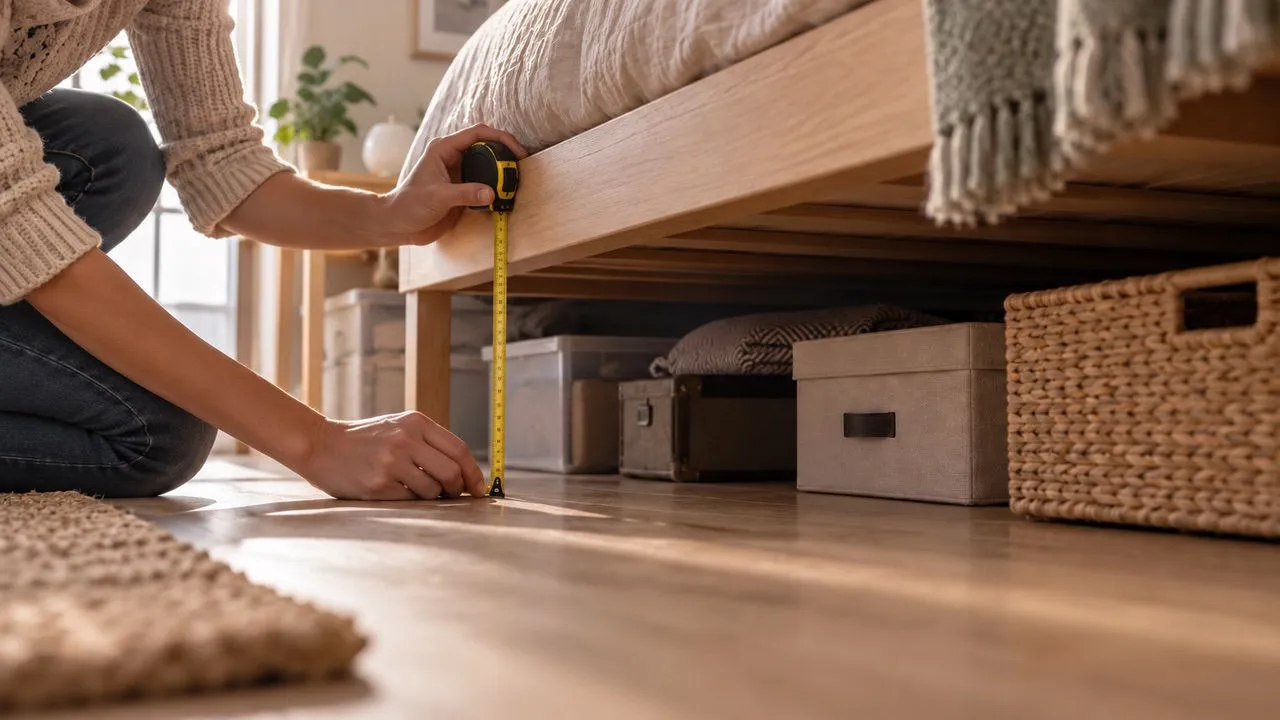
The first step is to take three measurements. The first isthe clearance between the floor and the bed frame. The second is the available depth. The third— which is often overlooked—is the space needed in front of the bed to pull out whatever we put underneath. This last measurement is crucial. A storage container may fit perfectly under the bed but be unusable if there isn’t enough space in front of it to pull it out. The same applies to drawers and rolling carts: you must always account for the space they occupy when in use, not just when the unit is closed. How often you access the items also affects the design. Seasonal items can be stored in the deepest, least accessible areas. Items we use daily, on the other hand, should be placed near the edge or in a freestanding, easily accessible unit.
Standard Bed: Low Boxes, Storage Containers with Wheels, and Vacuum-Sealed
Storage
If you have a traditional bed with only a few centimeters of free space, the simplest solution is to use low, wide storage containers. Closed boxes, fabric models with zippers, and storage containers with wheels allow you to make use of space that would otherwise remain empty. This setup is particularly suitable for bedding, blankets, out-of-season clothing, and items you don’t need to access every day. Duvets and particularly bulky textiles can be compressed using vacuum-sealed bags, significantly reducing the space they take up. However, it’s important not to turn the space under the bed into a haphazard storage area. It’s best to sort the contents by category, use closed containers, and label them if necessary. The lower and deeper the space, the more important it is to know exactly what’s inside.
Classic storage bed: use the entire surface area under the mattress
The next step is the traditional storage bed . In this case, the structure creates a single, large compartment beneath the base and mattress, accessible via a lifting system. It’s a highly effective solution for exploiting a large surface area without increasing the bed’s overall size. In our in-depth analysis of how a storage bed works, we explored the differences between storage compartments, opening systems, and other forms of storage. The large compartment is particularly suitable for duvets, pillows, blankets, suitcases, and seasonal items. It becomes less convenient when the space is used daily, as the bed must be opened to access its contents. This is one of the reasons why, when used frequently, it can be more beneficial to divide the space into independent elements.
Drawers and chests of drawers: transforming the underbed into a chest of drawers
If your goal is to utilize space every day, under-bed drawers are a very practical development. The bed surface remains stationary, and each compartment opens from the front: there’s no need to lift the bed base and mattress. In bedrooms with SpazioBed drawers , the lower volume becomes a true storage area. It’s possible to separate linens, knitwear, clothes, and personal items, avoiding the large, single compartment of the trunk. A concrete example is the Torino 1 double bedroom , where the raised bed allows for eight drawers to be integrated under the sleeping area. In children’s bedrooms, the same principle is applied, for example, in the Be Happy bedroom , combining drawers and additional pull-out elements. The advantage isn’t just having more space: it’s making that space immediately usable .
Pull-out carts: the space under the bed becomes a mobile closet
When more depth is needed, the drawer can be converted into a full-fledged pull-out cart. The carts can be organized with shelves or clothes rods and make use of a much larger portion of the bed’s depth. Bedrooms featuring SpazioBed pull-out units are designed with this very concept in mind. One example is the Firenze loft bed with pull-out units: the space beneath the bed frame is filled with movable units that can be pulled out as needed.
From a design perspective, however, the space in front of the drawers must also be taken into account. The deeper they are, the greater the storage capacity, but the space required for pulling them out and their weight when full also increase. Cinius recommends choosing the depth based on everyday practicality: the technical page dedicated to the SpazioBed bed with pull-out drawers explains the various options in detail.
Under-bed closet: when the space under the bed becomes a real wardrobe
By further raising the structure, the lower space can cease to be a simple container and become a real wardrobe under the bed . In bedrooms with a wardrobe underneath , the space can be organized with hangers, shelves, and sliding doors. This way, the bed and wardrobe use the same surface area of the room on two different levels. The Milano double bedroom is an example of this setup for adults. In children’s bedrooms, however, the Marina bedroom uses the loft bed to create a wardrobe and other modules underneath. For children’s bedrooms, there are also true bedrooms with walk-in wardrobes , in which the vertical layout allows the sleeping area and wardrobe to be concentrated in the same space. Those interested in learning more about these solutions can also consult the Cinius page dedicated to space-saving beds for adults .
More Than Just a Closet: Bookcases, Desks, and Multifunctional Compartments
The space under the bed doesn’t have to be reserved solely for clothes. The ability to choose different heights allows you to design the lower section based on the room’s actual needs. One section can be filled with drawers, another with shelves, and another with a compartment for suitcases. The stairs themselves can incorporate additional drawers. In other configurations, bookshelves or work surfaces can be incorporated, avoiding the need to place many separate pieces of furniture along the walls. The bedrooms with bookshelves demonstrate how the concept can be extended to store books and other items, while in the single-bed children’s rooms, the same space can be organized around the study, wardrobe, and storage needs of children and teens. The design principle remains the same: first, you decide what the space is meant to do; then, you choose how to divide it.
What should you put under the bed? It depends on how often you need it
A simple way to organize the space under the bed is to sort items based on how often you use them:
- Daily use: Clothes, personal linens, and accessories are best stored in easily accessible drawers, carts, or closets;
- occasional use: spare sheets, towels, and equipment can be stored in deeper compartments;
- seasonal use: comforters, blankets, and seasonal clothing can be stored in boxes or vacuum-sealed bags in less accessible areas.
This distinction helps avoid one of the most common mistakes: using a lot of storage space but using it inefficiently. An item you need every morning shouldn’t be hidden at the bottom of a storage unit under five other containers. Dust protection should also be considered. Sealed boxes and properly designed storage systems help protect the contents; this topic is covered in more detail in the guide on how to keep dust out of a storage bed. For general information on particulate matter in the home, you can also consult the U.S. Environmental Protection Agency.
Making use of the space under the bed in a bedroom
In children’s bedrooms, the storage space under the bed can be even more valuable, as the same space must include a sleeping area, wardrobe, study, play area, and passageway. Small bedrooms clearly demonstrate how vertical design allows you to avoid taking up all the walls with freestanding furniture. The space under the bed can be used as a wardrobe, chest of drawers, clothes rack, or a combination of these functions. This logic complements the one explained in the guide on how to save space in a child’s bedroom : here, however, the focus is not on the entire room but specifically on the space beneath the sleeping surface.
Making the Most of the Space Under the Bed in a Master Bedroom
In adult bedrooms, the challenge is different. The double bed already takes up a significant amount of space and often has to share the room with a spacious closet, dressers, and other storage units. SpazioBed double bedrooms use this very space as a starting point: the bed is raised, and the space underneath takes on the function that would normally require another piece of furniture. This approach is particularly useful when furnishing a small bedroom, because it allows you to think in cubic meters rather than just square meters.
In studio apartments, every cubic centimeter is even more valuable
This principle becomes even more evident in small apartments. In studio apartments, the space under the bed can accommodate a wardrobe, drawers, a desk, or other items that would otherwise take up space in the living area. The difference compared to simply tucking a few boxes under a standard bed is substantial: the space underneath is designed from the outset as part of the furniture. This, ultimately, is the logic behind SpazioBed: don’t just ask what can fit under your existing bed, but ask what function that space could serve if the bed were designed at the right height.
Space Under the Bed: Choose the Function First, Then the Storage Solution
There’s no one-size-fits-all solution for truly making the most of the space under the bed. If there are only a few centimeters of free space, low, vacuum-sealed boxes may be sufficient. If you need ample seasonal storage, the classic storage bed remains an effective solution. If, on the other hand, that space needs to be used daily, drawers, rolling carts, and cabinets become much more appealing. The real design breakthrough comes when you stop thinking of the space under the bed as leftover space. By raising the sleeping area, that same space can become a chest of drawers, a wardrobe, a bookshelf, a walk-in closet, or a multifunctional system.
So the question to ask isn’t just “How much space do I have under the bed?”, but above all “What do I want to use that space for?”. The most effective solution comes from the answer to that question .